Advertisements
Advertisements
प्रश्न
Show that intensity of electric field at a point in broadside position of an electric dipole is given by:
E = `(1/(4 pi epsilon_0)) p/((r^2 + l^2)^(3//2))`
Where the terms have their usual meaning.
Show that intensity of electric field E at a point in broadside on position is given by:
E = `(1/(4 pi epsilon_0)) p/((r^2 + l^2)^(3//2))`,
where the terms have their usual meaning.
Advertisements
उत्तर
Consider a dipole of length 2l and moment `vec p`.
From the figure, resultant electric field intensity at C:
`vec E = vec E_A + vec E_B`
`|vec E_A| = 1/(4 pi epsilon_0) q/(r^2 + l^2)`
`|vec E_B| = 1/(4 pi epsilon_0) q/(r^2 + l^2)`
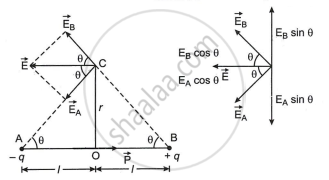
Sine components of `vec E_A` and `vec E_B` get cancelled each other as `|vec E_A| = |vec E_B|`.
The cosine components get added up to give the resultant field.
i.e., E = EA cos θ + EB cos θ
= `1/(4 pi epsilon_0) * q/(r^2 + l^2) cos theta + 1/(4 pi epsilon_0) * q/(r^2 + l^2) cos theta`
= `2 * 1/(4 pi epsilon_0) * q/(r^2 + l^2) cos theta`
= `2 xx 1/(4 pi epsilon_0) * q/(r^2 + l^2) xx l/(r^2 + l^2)^(1//2)`
= `1/(4 pi epsilon_0) (q(2 l))/((r^2 + l^2)^(3//2))`
E = `1/(4 pi epsilon_0) p/((r^2 + l^2)^(3//2))` ...[as p = q(2l)]
The above expression gives the magnitude of the field. The direction of the electric field E at C is opposite to the direction of the dipole moment `vec p`.
संबंधित प्रश्न
An electric dipole is placed at the centre of a sphere. Mark the correct options.
(a) The flux of the electric field through the sphere is zero.
(b) The electric field is zero at every point of the sphere.
(c) The electric field is not zero anywhere on the sphere.
(d) The electric field is zero on a circle on the sphere.
Two particles A and B, of opposite charges 2.0 × 10⁻⁶ C and −2.0 × 10⁻⁶ C, are placed at a separation of 1.0 cm. Calculate the electric field at a point on the perpendicular bisector of the dipole and 1.0 m away from the centre.
An electric dipole of moment p is placed parallel to the uniform electric field. The amount of work done in rotating the dipole by 90° is ____________.
A square surface of side l (m) in the plane of the paper. A uniform electric field E(V/m) also in the plane of the paper is limited only to the lower half of the square surface, the electric flux (in SI units) associated with the surface is ______.
The direction of the dipole axis is defined as the line pointing from:
The direction of the electric field on the equatorial line of a dipole is:
How does the electric potential due to a dipole vary with distance compared to that of a point charge?
Hydrogen chloride (HCl) has a large dipole moment because:
Carbon dioxide (CO₂) has zero net dipole moment even though it contains polar C=O bonds. Why?
