Topics
Electric Charges and Fields
- Electric Charges
- Conductors and Insulators
- Properties of Electric Charge
- Coulomb’s Law
- Forces between Multiple Charges
- Electric Field
- Electric Field Due to a System of Charges
- Physical Significance of Electric Field
- Electric Field Lines
- Electric Flux
- Electric Dipole
- Dipole in a Uniform External Field
- Continuous Charge Distribution
- Gauss’s Law
- Application of Gauss' Law
Electrostatics
Current Electricity
Electrostatic Potential and Capacitance
- Electric Potential and Potential Energy
- Electrostatic Potential
- Electric Potential Due to a Point Charge
- Potential Due to an Electric Dipole
- Potential due to a System of Charges
- Equipotential Surfaces
- Relation Between Electric Field and Electrostatic Potential
- Potential Energy of a System of Charges
- Potential Energy of a Single Charge
- Potential Energy of a System of Two Charges in an External Field
- Potential Energy of a Dipole in an External Field
- Electrostatics of Conductors
- Dielectrics and Polarisation
- Capacitors and Capacitance
- The Parallel Plate Capacitor
- Effect of Dielectric on Capacitance
- Combination of Capacitors
- Energy Stored in a Charged Capacitor
Magnetic Effects of Current and Magnetism
Current Electricity
- Electric Current
- Electric Currents in Conductors
- Ohm's Law
- Drift of Electrons and the Origin of Resistivity
- Mobility of Electrons
- Limitations of Ohm’s Law
- Resistivity of Various Materials
- Temperature Dependence of Resistivity
- Electrical Energy and Power in Conductors
- Cells, EMF, and Internal Resistance
- Cells in Series and in Parallel
- Kirchhoff’s Laws
- Wheatstone Bridge
Moving Charges and Magnetism
- Electromagnetism
- Magnetic force
- Motion in a Magnetic Field
- Magnetic Field Due to a Current-carrying Conductor: Biot-savart's Law
- Applications of Biot-Savart's Law > Magnetic Field at the Axis of a Circular Current-carrying Loop
- Ampere’s Circuital Law
- Solenoid
- Force Between Two Parallel Currents (Ampere’s Law)
- Torque on a Rectangular Current Loop in a Uniform Magnetic Field
- Circular Current Loop as a Magnetic Dipole
- Moving Coil Galvanometer
- Kirchhoff’s Laws
Electromagnetic Induction and Alternating Currents
Electromagnetic Waves
Magnetism and Matter
Optics
Electromagnetic Induction
Alternating Current
Dual Nature of Radiation and Matter
Atoms and Nuclei
Electromagnetic Waves
Electronic Devices
Ray Optics and Optical Instruments
- Ray Optics Or Geometrical Optics
- Reflection of Light by Spherical Mirrors
- Sign Convention for Reflection by Spherical Mirrors
- Focal Length of Spherical Mirrors
- Mirror Equation of Spherical Mirrors
- Refraction of Light
- Total Internal Reflection
- Applications of Total Internal Reflection
- Refraction at a Spherical Surfaces
- Refraction by a Lens
- Power of a Lens
- Combined Focal Length of Two Thin Lenses in Contact
- Refraction of Light through a Prism
- Introduction to Optical Instruments
- Microscope and it’s types
- Telescope
Wave Optics
- Introduction to Wave Optics
- Huygens Principle
- Refraction of a Plane Wave
- Refraction at a Rarer Medium
- Reflection of a Plane Wave by a Plane Surface
- Coherent and Incoherent Addition of Waves
- Interference of Light Waves and Young’s Experiment
- Diffraction of Light
- The Single Slit
- Seeing the Single Slit Diffraction Pattern
- Polarisation of Light
Communication Systems
Dual Nature of Radiation and Matter
- Understanding Dual Nature of Radiation and Matter
- Electron Emission
- Photoelectric Effect - Hertz’s Observations
- Photoelectric Effect - Hallwachs’ and Lenard’s Observations
- Experimental Study of Photoelectric Effect
- Effects of Intensity and Frequency on Photocurrent
- Photoelectric Effect and Wave Theory of Light
- Einstein’s Photoelectric Equation: Energy Quantum of Radiation
- Particle Nature of Light: The Photon
- Wave Nature of Matter
The Special Theory of Relativity
Atoms
Nuclei
Semiconductor Electronics - Materials, Devices and Simple Circuits
Communication Systems
- Detection of Amplitude Modulated Wave
- Production of Amplitude Modulated Wave
- Basic Terminology Used in Electronic Communication Systems
- Sinusoidal Waves
- Modulation and Its Necessity
- Amplitude Modulation (AM)
- Need for Modulation and Demodulation
- Satellite Communication
- Propagation of EM Waves
- Bandwidth of Transmission Medium
- Bandwidth of Signals
The Special Theory of Relativity
- The Special Theory of Relativity
- The Principle of Relativity
- Maxwell'S Laws
- Kinematical Consequences
- Dynamics at Large Velocity
- Energy and Momentum
- The Ultimate Speed
- Twin Paradox
Maharashtra State Board: Class 11
CISCE: Class 12
Introduction
Many molecules in nature (H₂O, HCl, NH₃) carry separated positive and negative charge centres. This charge separation, even at the molecular scale, creates measurable electric fields, influences chemical bonding, and forms the basis of dielectrics, capacitors, and biological systems.
Maharashtra State Board: Class 11
CISCE: Class 12
National Testing Agency: Class 12
Definition: Electric Dipole
An electric dipole is a pair of equal and opposite point charges placed at a short distance apart.
OR
A system formed by two equal and opposite point charges placed at a small distance apart is called an electric dipole.
OR
A system of two equal and opposite point charges +q and −q separated by a small fixed distance 2a is called an electric dipole.
- The total charge of an electric dipole is zero
- Zero net charge does not mean zero electric field - the field exists because the charges are spatially separated
- The midpoint of the line joining −q and +q is called the centre of the dipole
Maharashtra State Board: Class 11
CISCE: Class 12
Definition: Direction of Dipole Axis
“The line joining the two charges, pointing from the negative charge to the positive charge. This is known as the ‘direction of dipole axis’.”
OR
The line passing through both charges +q and −q is called the dipole axis (also called the axial line or axis of the dipole).
Maharashtra State Board: Class 11
Definition: Centre of Dipole
The midpoint of the line joining the two charges is called the centre of the dipole.
Maharashtra State Board: Class 11
Definition: Equatorial Line
The line passing through the centre of the dipole and perpendicular to the dipole axis is called the equatorial line.
OR
The plane passing through the centre of the dipole and perpendicular to the dipole axis is called the equatorial plane; the line along which the equatorial field is evaluated is the equatorial line (perpendicular bisector).
CISCE: Class 12
Definition: Electric Dipole Moment
Electric dipole moment \[\vec p\] is a vector quantity defined as the product of the magnitude of either charge and the separation between them.
Mathematical definition: \[\vec p\] = q × 2a
| Symbol | \[\vec p\] |
| Magnitude | p = q × 2a |
| Direction | From −q to +q (along the dipole axis) |
| SI Unit | Coulomb-metre (C·m) |
| Dimensional Formula | [M0L1T1A1] |
Electric Field Due to an Electric Dipole: Field at a Point on the Axial Line
Setup: Let P be a point on the axis of the dipole at a distance r from the centre O. The charge +q is at a distance (r − a) from P, and −q is at a distance (r + a) from P.
Derivation (Steps):
-
Field due to +q at P (directed away from +q, i.e., along \[\hat p\]):
\(E_+=\frac{1}{4\pi\varepsilon_0}\cdot\frac{q}{(r-a)^2}\) -
Field due to −q at P (directed toward −q, i.e., along \[\hat p\]):
\[E_-=\frac{1}{4\pi\varepsilon_0}\cdot\frac{q}{(r+a)^2}\] -
Both fields are along the same line (axial direction). Net field:
Eaxial = E+ −E− = \[\frac{q}{4\pi\varepsilon_0}\left[\frac{1}{(r-a)^2}-\frac{1}{(r+a)^2}\right]\] -
Simplifying:
Eaxial = \[\frac{1}{4\pi\varepsilon_0}\cdot\frac{4qar}{(r^2-a^2)^2}\] -
For a short dipole (r ≫ a), (r2 − a2)2 ≈ r4:
\[E_{axial}=\frac{1}{4\pi\varepsilon_0}\cdot\frac{2p}{r^3}\]
Direction: Along the direction of \[\vec p\] (from −q to +q).
CISCE: Class 12
Electric Field Due to an Electric Dipole: Field at a Point on the Equatorial Line
Setup: Let P be a point on the equatorial line at distance r from the centre O. Both charges are at equal distances from P: \[\sqrt{r^2+a^2}\].
Derivation (Steps):
-
Field due to each charge at P has equal magnitude:
E = \[\frac{1}{4\pi\varepsilon_0}\cdot\frac{q}{(r^2+a^2)}\] -
The components along the equatorial direction cancel (equal and opposite). Only the components parallel to the dipole axis survive.
-
Each contributes E cos θ, where cos θ = \[\frac{a}{\sqrt{r^2+a^2}}\]:
Eeq = \[2\cdot\frac{q}{4\pi\varepsilon_0(r^2+a^2)}\cdot\frac{a}{\sqrt{r^2+a^2}}=\frac{1}{4\pi\varepsilon_0}\cdot\frac{p}{(r^2+a^2)^{3/2}}\] -
For a short dipole (r ≫ a): Eeq = \[{\frac{1}{4\pi\varepsilon_0}\cdot\frac{p}{r^3}}\]
Direction: Opposite to \[\vec p\] (anti-parallel to dipole moment).
Maharashtra State Board: Class 11
CISCE: Class 12
Electric Field Due to an Electric Dipole: Axial vs. Equatorial Field
| Property | Axial (End-on) | Equatorial (Broad-side-on) |
|---|---|---|
| Formula (short dipole) | \[\frac{2p}{4\pi\varepsilon_0r^3}\] | \[\frac{p}{4\pi\varepsilon_0r^3}\] |
| Direction | Along \[\vec p\] | Opposite to \[\vec p\] |
| Magnitude ratio | Eaxial = 2Eeq | — |
| Distance dependence | Falls as 1/r3 | Falls as 1/r3 |
| Condition | r ≫ a | r ≫ a |
Dipole in a Uniform External Electric Field
Force on the Dipole
When a dipole is placed in a uniform electric field \[\vec E\]:
- Force on +q: F = qE (along \[\vec E\])
- Force on −q: F = qE (opposite to \[\vec E\])
- Net translational force = 0 (forces are equal and opposite)
The dipole does not translate in a uniform field — it only rotates.
Torque on the Dipole
When the dipole makes an angle θ with the field direction, each charge experiences a force qE. The perpendicular distance between the forces is 2a sin θ.
τ = qE ⋅ 2a sin θ = pE sin θ
Vector form:
\[\vec τ\] = \[\vec p\] × \[\vec E\]
- Torque tends to align the dipole along the field direction
- Maximum torque: τmax = pE when θ = 90°
- Torque = 0 when θ = 0° (aligned) or θ = 180° (anti-aligned)
CISCE: Class 12
Potential Energy of a Dipole in External Field
The work done against the torque to rotate the dipole from θ1 to θ2 is stored as potential energy.
W = \[-\int_{\theta_1}^{\theta_2}\tau d\theta=pE(\cos\theta_1-\cos\theta_2)\]
Taking θ1 = 90° as reference (zero potential energy):
U = −pE cos θ = −\[\vec p\] ⋅ \[\vec E\]
Equilibrium Conditions
| Condition | θ | Torque | Potential Energy | Equilibrium Type |
|---|---|---|---|---|
| Aligned with \[\vec E\] | 0° | 0 | −pE (minimum) | Stable |
| Perpendicular to \[\vec E\] | 90° | Maximum | 0 | Not in equilibrium |
| Anti-aligned (opposite) | 180° | 0 | +pE (maximum) | Unstable |
Electric Potential Due to a Dipole
For a point P at distance r from the centre and at angle θ with the dipole axis:
V = \[\frac{1}{4\pi\varepsilon_0}\cdot\frac{p\cos\theta}{r^2}\quad(r\gg a)\]
| Case | θ | Potential |
|---|---|---|
| On axial line | 0° or 180° | ±\[\frac{p}{4\pi\varepsilon_0r^2}\] |
| On equatorial line | 90° | 0 (zero potential) |
Potential falls as 1/r2 for a dipole, compared to 1/r for a point charge.
Maharashtra State Board: Class 11
Electric Dipoles in Nature
Electric dipoles are not just theoretical — they appear in numerous real-world systems:
- Water (H₂O): Bent molecular geometry causes unequal charge distribution → net dipole moment (~1.85 D)
- Hydrochloric acid (HCl): Highly polar covalent bond → large dipole moment
- Ammonia (NH₃): Pyramidal structure → net dipole
- Carbon dioxide (CO₂): Linear and symmetric → dipole moments cancel → zero net dipole
Polar molecules have a permanent dipole moment; non-polar molecules have zero dipole moment because bond dipoles cancel.
Example 1
Given: ±10 μC charges, 5 mm apart; find field at P (15 cm on the axis) and Q (15 cm on the equatorial line).
(a) At point P (axial line):
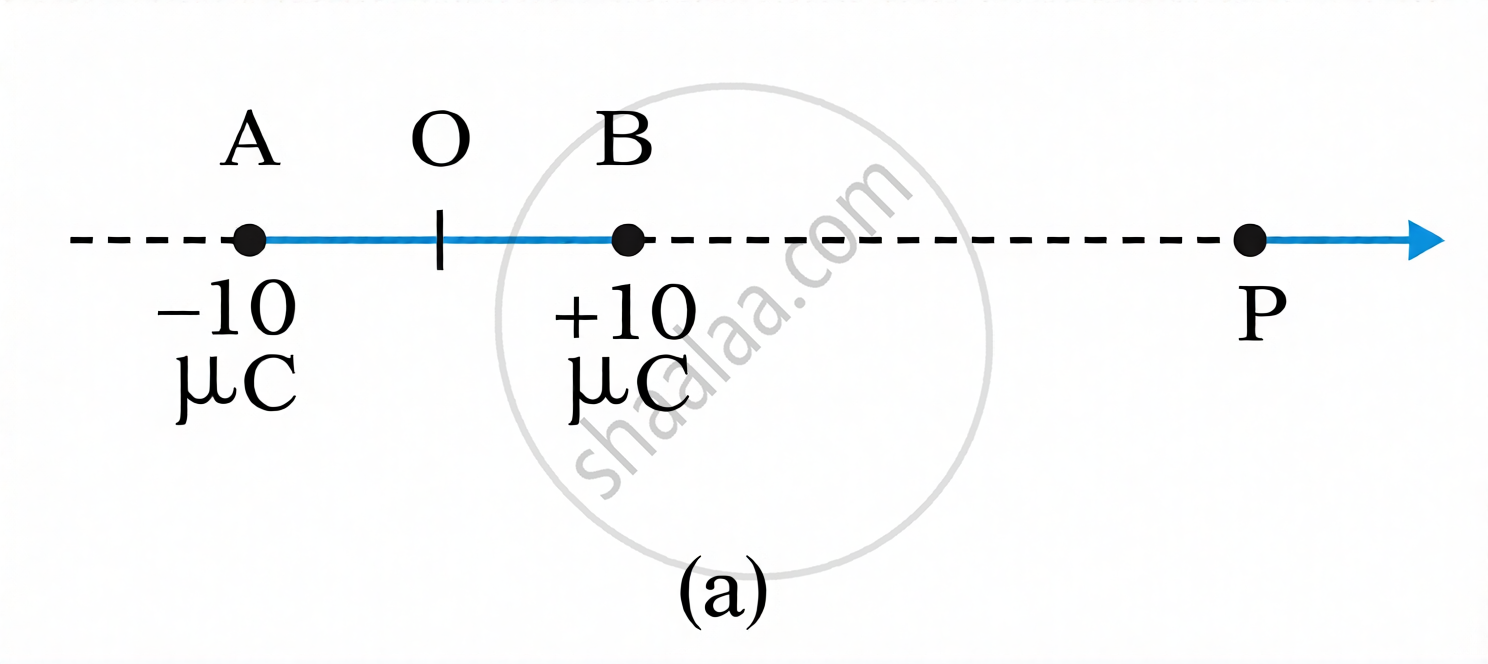
- Field due to +10 μC: 4.13 × 10⁶ N/C along BP
- Field due to –10 μC: 3.86 × 10⁶ N/C along PA
- Net field (subtract, same line): 2.7 × 10⁶ N/C along BP
- Since r/a = 60 (large), use short-dipole formula: E = \[\frac {2p}{4πε_0r^3}\]
- Dipole moment: p = 10−5 × 5 × 10−3 = 5 × 10⁻⁸ C m
- Result: E = 2.6 × 10⁵ N/C along AB — matches step 3 closely
(b) At point Q (equatorial line):
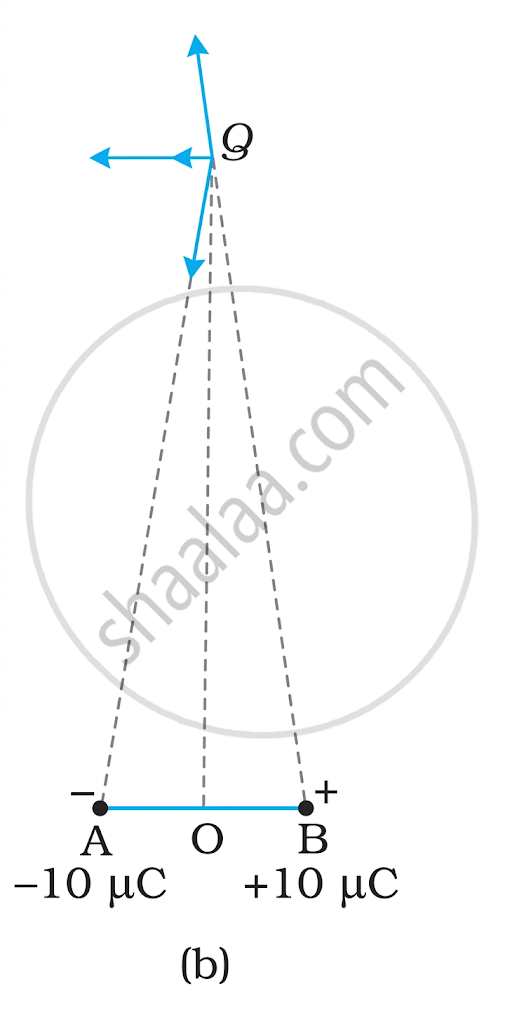
- Field due to +10 μC: 3.99 × 10⁶ N/C along BQ
- Field due to –10 μC: 3.99 × 10⁶ N/C along QA
- Components along OQ cancel; components along BA add
- Net field: 1.33 × 10⁵ N/C along BA
- Using formula E = \[\frac {p}{4πε_0r^3}\]: same result, 1.33 × 10⁵ N/C, direction opposite to dipole moment
Example 2
Given: qA = +0.25 μC at (0,0,–15 cm), qB = −0.25 μC at (0,0,15 cm)
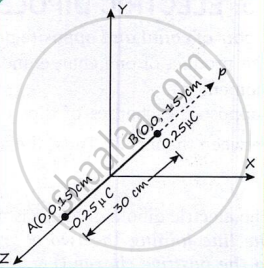
- Net charge = 0 (equal and opposite)
- p = q × 2l = 0.25 × 10−6 × 30 × 10−2 = 7.5 × 10⁻⁸ C-m
- Direction: from –q to +q, i.e. along –Z axis
- Motion: no net force → no translation; unequal line of action of forces → torque → dipole rotates (aligns or oscillates)
Example 3
Given: +q, –2q, +q at vertices of equilateral triangle, side 2l
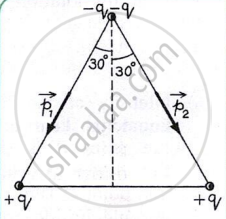
- Treat as two dipoles, each of moment p1 = p2 = q × 2l
- Add components: p = p1 cos30° + p2 cos 30°
- Simplify: p = 4ql cos30° = 2\[\sqrt 3\] ql
