Advertisements
Advertisements
प्रश्न
It is said that the separation between the two charges forming an electric dipole should be small. In comparison to what should this separation be small?
Advertisements
उत्तर
The separation between the two charges forming an electric dipole should be small compared to the distance of a point from the centre of the dipole at which the influence of the dipole field is observed.
APPEARS IN
संबंधित प्रश्न
Find the resultant electric field due to an electric dipole of dipole moment, 2aq, (2a being the separation between the charges ±± q) at a point distant 'x' on its equator.
An electric dipole of length 2 cm, when placed with its axis making an angle of 60° with a uniform electric field, experiences a torque of \[8\sqrt{3}\] Nm. Calculate the potential energy of the dipole, if it has a charge \[\pm\] 4 nC.
An electric dipole of length 1 cm, which placed with its axis making an angle of 60° with uniform electric field, experience a torque of \[6\sqrt{3} Nm\] . Calculate the potential energy of the dipole if it has charge ±2 nC.
In which orientation, a dipole placed in a uniform electric field is in (i) stable, (ii) unstable equilibrium?
Two charges + 3.2 x 10⁻¹⁹ C and --3.2 x 10⁻¹⁹ C placed at 2.4 Å apart to form an electric dipole. lt is placed in a uniform electric field of intensity 4 x 10⁵ volt/m. The electric dipole moment is ______.
On the axis and on the equator of an electric dipole for all points ____________.
The unit of electric dipole moment is ______.
An electric dipole of moment p is placed parallel to the uniform electric field. The amount of work done in rotating the dipole by 90° is ____________.
Polar molecules are the molecules ______.
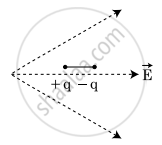
A dipole is placed in an electric field as shown. In which direction will it move?
Show that intensity of electric field at a point in broadside position of an electric dipole is given by:
E = `(1/(4 pi epsilon_0)) p/((r^2 + l^2)^(3//2))`
Where the terms have their usual meaning.
In an electric dipole, what is the locus of a point having zero potential?
Which line is defined as passing through the centre of a dipole and perpendicular to the dipole axis?
For a short dipole, the ratio of the electric field on the axial line to that on the equatorial line (at the same distance r) is:
When a dipole is aligned with the external electric field (θ = 0°), the potential energy is:
On the equatorial line of a dipole (θ = 90°), the electric potential is:
Carbon dioxide (CO₂) has zero net dipole moment even though it contains polar C=O bonds. Why?
A configuration consists of charges +q, −2q, and +q at the vertices of an equilateral triangle with side length 2l. Treating this as a combination of two dipoles, what is the net dipole moment?
