Advertisements
Advertisements
प्रश्न
Arrangement of an oxygen ion and two hydrogen ions in a water molecule is shown in the figure below.
Calculate the electric dipole moment of a water molecule. Express your answer in terms of e (charge on hydrogen ions), l and θ.

Advertisements
उत्तर
P1 = P2 = e × l
P = 2p cos α
= `2 e xx l cos (theta/2)`
संबंधित प्रश्न
Derive the expression for the electric potential due to an electric dipole at a point on its axial line.
Depict the equipotential surfaces due to an electric dipole.
Write the expression for the torque \[\vec{\tau}\] acting on a dipole of dipole moment \[\vec{p}\] placed in an electric field \[\vec{E}\].
An electric dipole of length 1 cm, which placed with its axis making an angle of 60° with uniform electric field, experience a torque of \[6\sqrt{3} Nm\] . Calculate the potential energy of the dipole if it has charge ±2 nC.
An electric dipole is placed at the centre of a sphere. Mark the correct options.
(a) The flux of the electric field through the sphere is zero.
(b) The electric field is zero at every point of the sphere.
(c) The electric field is not zero anywhere on the sphere.
(d) The electric field is zero on a circle on the sphere.
Answer the following question.
Derive an expression for the electric field at any point on the equatorial line of an electric dipole.
Polar molecules are the molecules ______.
A dipole is placed in an electric field as shown. In which direction will it move?
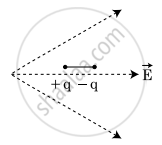
In an electric dipole, what is the locus of a point having zero potential?
The dimensional formula for electric dipole moment is:
