Advertisements
Advertisements
प्रश्न
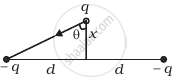
Two charges –q each are fixed separated by distance 2d. A third charge q of mass m placed at the mid-point is displaced slightly by x(x << d) perpendicular to the line joining the two fixed charged as shown in figure. Show that q will perform simple harmonic oscillation of time period.
`T = [(8pi^3 ε_0 md^3)/q^2]^(1/2)`
Advertisements
उत्तर
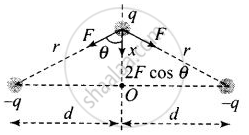
Let the charge q is displaced slightly by x(x << d) perpendicular to the line joining the two fixed charges. Net force on the charge q will be towards O. The motion of charge q to be simple harmonic, if the force on charge q must be proportional to its distance from the centre O and is directed towards O.
Net force on the charge Fnet = 2F cos θ
Here F = `1/(4piε_0) (q(q))/r^2 = 1/(4piε_0) q^2/((d^2 + x^2))`
And cos θ = `x/sqrt(x^2 + d^2)`
Hence, Fnet = `2[1/(4piε_0) q^2/((d^2 + x^2))][x/sqrt(x^2 + d^2)]`
= `1/(2piε_0) (q^2x)/(d^2 + x^2)^(3/2)`
= `1/(2piε_0) (q^2x)/(d^3 (1 + x^2/d^2)^(3/2)`
As x << d, then Fnet = `1/(2piε_0) (q^2x)/d^3` or Fnet = Kx
i.e., force on charge q is proportional to its displacement from the centre O and it is directed towards O. Hence, motion of charge q would be simple harmonic, where ω = `sqrt(K/m)`
And T = `(2pi)/ω = 2pi sqrt(m/K)`
⇒ T = `2pi sqrt((m * 4piε_0 d^3)/(2q^2)) = [(8pi^3ε_0 md^3)/q^2]^(1/2)`
APPEARS IN
संबंधित प्रश्न
- Define torque acting on a dipole of dipole moment \[\vec{p}\] placed in a uniform electric field \[\vec{E}\] Express it in the vector from and point out the direction along which it acts. Express it in the vector from and point out the direction along which it acts.
- What happens if the field is non-uniform?
- What would happen if the external field
\[\vec{E}\] is increasing (i) parallel to \[\vec{p}\] and (ii) anti-parallel to \[\vec{p}\]?
An electric dipole is placed in an electric field generated by a point charge.
An electric dipole is placed at the centre of a sphere. Mark the correct options.
(a) The flux of the electric field through the sphere is zero.
(b) The electric field is zero at every point of the sphere.
(c) The electric field is not zero anywhere on the sphere.
(d) The electric field is zero on a circle on the sphere.
Two particles, carrying charges −q and +q and and of mass m each, are fixed at the ends of a light rod of length a to form a dipole. The rod is clamped at an end and is placed in a uniform electric field E with the axis of the dipole along the electric field. The rod is slightly tilted and then released. Neglecting gravity, find the time period of small oscillations.
A metal sphere of radius 1 cm is given a charge of 3.14 µC. Find the electric intensity at a distance of 1 m from the centre of sphere.
`[epsilon_0 = 8.85 xx 10^-12 "F"//m]`
The electric field at a point on the equatorial plane at a distance r from the centre of a dipole having dipole moment `vec "p"` is given by, (r >> separation of two charges forming the dipole, `epsilon_0 - ` permittivity of free space) ____________.
Electric charges q, q, - 2q are placed at the comers of an equilateral triangle ABC of side l. The magnitude of electric dipole moment of the system is ____________.
Polar molecules are the molecules ______.
A square surface of side l (m) in the plane of the paper. A uniform electric field E(V/m) also in the plane of the paper is limited only to the lower half of the square surface, the electric flux (in SI units) associated with the surface is ______.
Arrangement of an oxygen ion and two hydrogen ions in a water molecule is shown in the figure below.
Calculate the electric dipole moment of a water molecule. Express your answer in terms of e (charge on hydrogen ions), l and θ.

The midpoint of the line joining the negative and positive charges in an electric dipole is called the:
The direction of the dipole axis is defined as the line pointing from:
Which line is defined as passing through the centre of a dipole and perpendicular to the dipole axis?
The electric dipole moment \[\vec{p}\] is defined mathematically as:
On the equatorial line of a dipole (θ = 90°), the electric potential is:
How does the electric potential due to a dipole vary with distance compared to that of a point charge?
For the configuration with +0.25 μC at (0, 0, −15 cm) and −0.25 μC at (0, 0, +15 cm), the direction of the dipole moment is:
