Advertisements
Advertisements
प्रश्न
Depict the orientation of the dipole in (i) stable, (ii) unstable equilibrium in a uniform electric field.
Advertisements
उत्तर
Depicting the orientation of the dipole in
(i) stable equilibrium in a uniform electric field
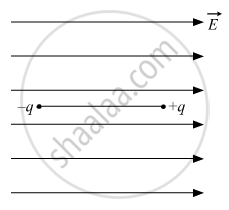
Net force is zero in this case as qE - qE = 0
Net torque = pEsinθ as θ = 0°
(ii) unstable equilibrium in a uniform electric field.
Net force is negative in this case as - qE - qE = -2qE
Net torque = pEsinθ as θ = 180°
APPEARS IN
संबंधित प्रश्न
Depict the equipotential surfaces due to an electric dipole.
Find the resultant electric field due to an electric dipole of dipole moment, 2aq, (2a being the separation between the charges ±± q) at a point distant 'x' on its equator.
Answer the following question.
What is the unit of dipole moment?
The unit of electric dipole moment is ______.
Polar molecules are the molecules ______.
The electric field in a region is given by `vec"E" = 2/5"E"_0hat"i"+3/5"E"_0hat"j"` with `"E"_0 = 4.0xx10^3 "N"/"C"`. The flux of this field through a rectangular surface area 0.4 m2 parallel to the Y - Z plane is ______ Nm2C-1.
Show that intensity of electric field at a point in broadside position of an electric dipole is given by:
E = `(1/(4 pi epsilon_0)) p/((r^2 + l^2)^(3//2))`
Where the terms have their usual meaning.
Arrangement of an oxygen ion and two hydrogen ions in a water molecule is shown in the figure below.
Calculate the electric dipole moment of a water molecule. Express your answer in terms of e (charge on hydrogen ions), l and θ.

The direction of the electric field on the equatorial line of a dipole is:
