Advertisements
Advertisements
Question
Depict the orientation of the dipole in (i) stable, (ii) unstable equilibrium in a uniform electric field.
Advertisements
Solution
Depicting the orientation of the dipole in
(i) stable equilibrium in a uniform electric field
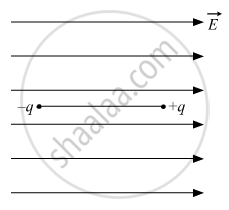
Net force is zero in this case as qE - qE = 0
Net torque = pEsinθ as θ = 0°
(ii) unstable equilibrium in a uniform electric field.
Net force is negative in this case as - qE - qE = -2qE
Net torque = pEsinθ as θ = 180°
APPEARS IN
RELATED QUESTIONS
Write the expression for the torque \[\vec{\tau}\] acting on a dipole of dipole moment \[\vec{p}\] placed in an electric field \[\vec{E}\].
Define electric dipole moment.
An electric dipole is placed at the centre of a sphere. Mark the correct options.
(a) The flux of the electric field through the sphere is zero.
(b) The electric field is zero at every point of the sphere.
(c) The electric field is not zero anywhere on the sphere.
(d) The electric field is zero on a circle on the sphere.
Answer the following question.
What is the unit of dipole moment?
The ratio of the weight of a man in a stationary lift and in a lift accelerating downwards with a uniform acceleration α is 3 : 2. The acceleration of the lift is:
In a non-uniform electric field, electric dipole experiences:-
The midpoint of the line joining the negative and positive charges in an electric dipole is called the:
The dimensional formula for electric dipole moment is:
When a dipole is anti-aligned with the external electric field (θ = 180°), the potential energy is:
Hydrogen chloride (HCl) has a large dipole moment because:
