Advertisements
Advertisements
Question
In which orientation, a dipole placed in a uniform electric field is in (i) stable, (ii) unstable equilibrium?
Advertisements
Solution
A dipole placed in a uniform electric filed is in
Stable equilibrium when the electric field is directed along the direction of the dipole i.e., when `vecE` is parallel to`vecp`.
Unstable equilibrium when the electric filed is directed at an angle of 180 degrees with the direction of the dipole, i.e., when `vecE` is anti-parallel to`vecp`.
APPEARS IN
RELATED QUESTIONS
Find the resultant electric field due to an electric dipole of dipole moment, 2aq, (2a being the separation between the charges ±± q) at a point distant 'x' on its equator.
Define electric dipole moment.
It is said that the separation between the two charges forming an electric dipole should be small. In comparison to what should this separation be small?
An electric dipole is placed at the centre of a sphere. Mark the correct options.
(a) The flux of the electric field through the sphere is zero.
(b) The electric field is zero at every point of the sphere.
(c) The electric field is not zero anywhere on the sphere.
(d) The electric field is zero on a circle on the sphere.
Two particles A and B, of opposite charges 2.0 × 10⁻⁶ C and −2.0 × 10⁻⁶ C, are placed at a separation of 1.0 cm.
In an electric dipole, at which point is the electric potential zero ?
The electric field at a point on the equatorial plane at a distance r from the centre of a dipole having dipole moment `vec "p"` is given by, (r >> separation of two charges forming the dipole, `epsilon_0 - ` permittivity of free space) ____________.
The ratio of the weight of a man in a stationary lift and in a lift accelerating downwards with a uniform acceleration α is 3 : 2. The acceleration of the lift is:
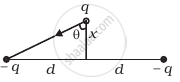
Two charges –q each are fixed separated by distance 2d. A third charge q of mass m placed at the mid-point is displaced slightly by x(x << d) perpendicular to the line joining the two fixed charged as shown in figure. Show that q will perform simple harmonic oscillation of time period.
`T = [(8pi^3 ε_0 md^3)/q^2]^(1/2)`