Advertisements
Advertisements
Question
Two particles A and B, of opposite charges 2.0 × 10⁻⁶ C and −2.0 × 10⁻⁶ C, are placed at a separation of 1.0 cm.
Advertisements
Solution
Given: Magnitude of charge (q) = 2.0 × 10⁻⁶ C
Separation between the charges (l) = 1.0 cm
Dipole moment (P) = q × l
P = 2 × 10−6 × 10−2
P = 2 × 10⁻⁸ C
APPEARS IN
RELATED QUESTIONS
Depict the equipotential surfaces due to an electric dipole.
Derive an expression for the intensity of electric field at a point in broadside position or on [4)
an equatorial line of an electric dipole.
Write the expression for the torque \[\vec{\tau}\] acting on a dipole of dipole moment \[\vec{p}\] placed in an electric field \[\vec{E}\].
Find the resultant electric field due to an electric dipole of dipole moment, 2aq, (2a being the separation between the charges ±± q) at a point distant 'x' on its equator.
An electric dipole of length 1 cm, which placed with its axis making an angle of 60° with uniform electric field, experience a torque of \[6\sqrt{3} Nm\] . Calculate the potential energy of the dipole if it has charge ±2 nC.
Define dipole moment of an electric dipole. Is it a scalar or a vector?
Two particles, carrying charges −q and +q and and of mass m each, are fixed at the ends of a light rod of length a to form a dipole. The rod is clamped at an end and is placed in a uniform electric field E with the axis of the dipole along the electric field. The rod is slightly tilted and then released. Neglecting gravity, find the time period of small oscillations.
In an electric dipole, at which point is the electric potential zero ?
A short electric dipole bas a dipole moment of 16 x 10-9 C m. The electric potential due to the dipole at a point at a distance of 0.6 m from the centre of the dipole, situated on a line making an angle of 60° with the dipole axis is: ____________. `(1/(4piepsilon_0) = 9 xx 10^9 "Nm"^2// "C"^2)`
The unit of electric dipole moment is ______.
The electric intensity due to a dipole of length 10 cm and having a charge of 500 µC, at a point on the axis at a distance 20 cm from one of the charges in air, is:
The region surrounding a stationary electric dipole has ______
A dipole is placed in an electric field as shown. In which direction will it move?

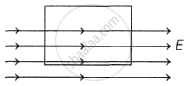
A square surface of side l (m) in the plane of the paper. A uniform electric field E(V/m) also in the plane of the paper is limited only to the lower half of the square surface, the electric flux (in SI units) associated with the surface is ______.
Show that intensity of electric field at a point in broadside position of an electric dipole is given by:
E = `(1/(4 pi epsilon_0)) p/((r^2 + l^2)^(3//2))`
Where the terms have their usual meaning.
The SI unit of electric dipole moment is:
For a short dipole, the ratio of the electric field on the axial line to that on the equatorial line (at the same distance r) is:
A dipole is perpendicular to an external electric field (θ = 90°). What are the torque and potential energy?
Hydrogen chloride (HCl) has a large dipole moment because:
For the configuration with +0.25 μC at (0, 0, −15 cm) and −0.25 μC at (0, 0, +15 cm), the direction of the dipole moment is:
