Advertisements
Advertisements
Question
In an electric dipole, what is the locus of a point having zero potential?
Advertisements
Solution
The equatorial plane is the locus of a point having zero potential in an electric dipole.
APPEARS IN
RELATED QUESTIONS
Define dipole moment of an electric dipole. Is it a scalar or a vector?
Two particles A and B, of opposite charges 2.0 × 10⁻⁶ C and −2.0 × 10⁻⁶ C, are placed at a separation of 1.0 cm. Calculate the electric field at a point on the axis of the dipole 1.0 cm away from the centre.
The ratio of the weight of a man in a stationary lift and in a lift accelerating downwards with a uniform acceleration α is 3 : 2. The acceleration of the lift is:
Polar molecules are the molecules ______.
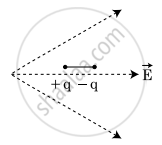
A dipole is placed in an electric field as shown. In which direction will it move?

A dipole is placed in an electric field as shown. In which direction will it move?
Show that intensity of electric field at a point in broadside position of an electric dipole is given by:
E = `(1/(4 pi epsilon_0)) p/((r^2 + l^2)^(3//2))`
Where the terms have their usual meaning.
The midpoint of the line joining the negative and positive charges in an electric dipole is called the:
The electric dipole moment \[\vec{p}\] is defined mathematically as:
