Advertisements
Advertisements
Question
An electric dipole of length 1 cm, which placed with its axis making an angle of 60° with uniform electric field, experience a torque of \[6\sqrt{3} Nm\] . Calculate the potential energy of the dipole if it has charge ±2 nC.
Advertisements
Solution
Torque,
Potential energy,
\[\frac{\tau}{U} = \frac{\left( Ql \right)E\sin\theta}{- \left( Ql \right)E\cos\theta} = - \tan\theta\]
\[ \Rightarrow U = - \frac{\tau}{\tan\theta}\]
\[ \Rightarrow U = - \frac{\tau}{\tan {60}^o}\]
\[ \Rightarrow U = - \frac{6\sqrt{3}}{\sqrt{3}}\]
\[ \Rightarrow U = - 6 J\]
APPEARS IN
RELATED QUESTIONS
A short electric dipole (which consists of two point charges, +q and -q) is placed at the centre 0 and inside a large cube (ABCDEFGH) of length L, as shown in Figure 1. The electric flux, emanating through the cube is:
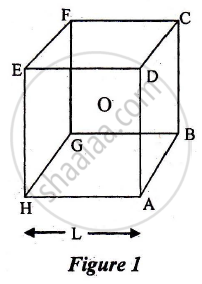
a) `q"/"4piin_9L`
b) zero
c) `q"/"2piin_0L`
d) `q"/"3piin_0L`
An electric dipole is placed at an angle of 30° with an electric field intensity of 2 × 10⁵ N/C. It experiences a torque equal to 4 Nm. The charge on the dipole, if the dipole length is 2 cm, is ______.
In a non-uniform electric field, electric dipole experiences:-
A dipole is placed in an electric field as shown. In which direction will it move?
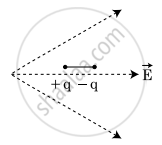
Eight dipoles of charges of magnitude e each are placed inside a cube. The total electric flux coming out of the cube will be ______.
The midpoint of the line joining the negative and positive charges in an electric dipole is called the:
In the derivation of the electric field at the equatorial line, why do the components perpendicular to the dipole axis cancel out?
The potential energy of a dipole in an external electric field is given by:
Carbon dioxide (CO₂) has zero net dipole moment even though it contains polar C=O bonds. Why?
For the configuration with +0.25 μC at (0, 0, −15 cm) and −0.25 μC at (0, 0, +15 cm), the direction of the dipole moment is:
