Advertisements
Advertisements
Question
Answer the following question.
Derive an expression for the electric field at any point on the equatorial line of an electric dipole.
Advertisements
Solution
Electric field for points on the equator plane
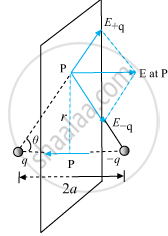
The magnitude of the electric field due to two charges +q and –q is
`E_(+q) = q/(4piε_0)1/(r^2 + a^2)`
`E_(-q) = q/(4piε_0)1/(r^2 + a^2)`
`E_(+q) = E_(-q)`
The directions of `E_(+q) and E_(-q)`, are as shown in the figure. The components normal to the dipole axis cancel away. The components along the dipole axis add up.
Total electric field, `E = -(E_(+q) + E_(-q)) costheta hatp` ......(Negative sign shows that the field is opposite to `hatp`)
`E = -(2qa)/(4piε_0(r^2 + a^2)^(3/2))hatp` ...(iii)
At large distance (r >> a), this reduces to,
`E = -(2qa)/(4piε_0r^3)hatp`
`vecp = q xx 2vecahatp`
`E = -vecp/(4piε_0r^3)` ....(r >> a)
RELATED QUESTIONS
An electric dipole of length 1 cm, which placed with its axis making an angle of 60° with uniform electric field, experience a torque of \[6\sqrt{3} Nm\] . Calculate the potential energy of the dipole if it has charge ±2 nC.
An electric dipole is placed in an electric field generated by a point charge.
An electric dipole is placed at the centre of a sphere. Mark the correct options.
(a) The flux of the electric field through the sphere is zero.
(b) The electric field is zero at every point of the sphere.
(c) The electric field is not zero anywhere on the sphere.
(d) The electric field is zero on a circle on the sphere.
Two particles, carrying charges −q and +q and and of mass m each, are fixed at the ends of a light rod of length a to form a dipole. The rod is clamped at an end and is placed in a uniform electric field E with the axis of the dipole along the electric field. The rod is slightly tilted and then released. Neglecting gravity, find the time period of small oscillations.
On the axis and on the equator of an electric dipole for all points ____________.
Electric dipole consists of two charges of magnitude 0.1 µC separated by a distance of 2 cm. The dipole is in 5 an external field of 105 N/C. What maximum torque does the field exert on the dipole?
A dipole is placed in an electric field as shown. In which direction will it move?
A dipole is perpendicular to an external electric field (θ = 90°). What are the torque and potential energy?
A configuration consists of charges +q, −2q, and +q at the vertices of an equilateral triangle with side length 2l. Treating this as a combination of two dipoles, what is the net dipole moment?
