Advertisements
Advertisements
Question
An electric dipole of length 4 cm, when placed with its axis making an angle of 60° with a uniform electric field, experiences a torque of `4sqrt3`Nm. Calculate the potential energy of the dipole, if it has charge ±8 nC
Advertisements
Solution
Torque, τ=PEsinθ=(Ql)Esinθ ...(1)
Here, l is the length of the dipole, Q is the charge and E is the electric field.
Potential energy, U=−PEcosθ=−(Ql)Ecosθ ...(2)
Dividing (2) by (1):
`T/U=((Ql)Esintheta)/(-(Ql)Ecostheta)=-tantheta`
`=>U=-T/(tantheta)`
`=>U=-T/(tan60^@)`
`=>U=(-4sqrt3)/sqrt3`
⇒U=−4 J
APPEARS IN
RELATED QUESTIONS
Find the resultant electric field due to an electric dipole of dipole moment, 2aq, (2a being the separation between the charges ±± q) at a point distant 'x' on its equator.
An electric dipole of length 1 cm, which placed with its axis making an angle of 60° with uniform electric field, experience a torque of \[6\sqrt{3} Nm\] . Calculate the potential energy of the dipole if it has charge ±2 nC.
Answer the following question.
Derive an expression for the electric field at any point on the equatorial line of an electric dipole.
Answer the following question.
What is the unit of dipole moment?
Two charges + 3.2 x 10⁻¹⁹ C and --3.2 x 10⁻¹⁹ C placed at 2.4 Å apart to form an electric dipole. lt is placed in a uniform electric field of intensity 4 x 10⁵ volt/m. The electric dipole moment is ______.
A short electric dipole bas a dipole moment of 16 x 10-9 C m. The electric potential due to the dipole at a point at a distance of 0.6 m from the centre of the dipole, situated on a line making an angle of 60° with the dipole axis is: ____________. `(1/(4piepsilon_0) = 9 xx 10^9 "Nm"^2// "C"^2)`
The region surrounding a stationary electric dipole has ______
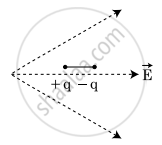
A dipole is placed in an electric field as shown. In which direction will it move?
For a short dipole, the ratio of the electric field on the axial line to that on the equatorial line (at the same distance r) is:
