Advertisements
Advertisements
प्रश्न
An electric dipole of length 4 cm, when placed with its axis making an angle of 60° with a uniform electric field, experiences a torque of `4sqrt3`Nm. Calculate the potential energy of the dipole, if it has charge ±8 nC
Advertisements
उत्तर
Torque, τ=PEsinθ=(Ql)Esinθ ...(1)
Here, l is the length of the dipole, Q is the charge and E is the electric field.
Potential energy, U=−PEcosθ=−(Ql)Ecosθ ...(2)
Dividing (2) by (1):
`T/U=((Ql)Esintheta)/(-(Ql)Ecostheta)=-tantheta`
`=>U=-T/(tantheta)`
`=>U=-T/(tan60^@)`
`=>U=(-4sqrt3)/sqrt3`
⇒U=−4 J
APPEARS IN
संबंधित प्रश्न
Drive the expression for electric field at a point on the equatorial line of an electric dipole.
An electric dipole of length 1 cm, which placed with its axis making an angle of 60° with uniform electric field, experience a torque of \[6\sqrt{3} Nm\] . Calculate the potential energy of the dipole if it has charge ±2 nC.
Define electric dipole moment. Is it a scalar or a vector? Derive the expression for the electric field of a dipole at a point on the equatorial plane of the dipole.
Answer the following question.
Derive an expression for the electric field at any point on the equatorial line of an electric dipole.
A conic surface is placed in a uniform electric field E as shown in the figure such that the field is perpendicular to the surface on the side AB. The base of the cone is of radius R, and the height of the cone is h. The angle of the cone is θ.
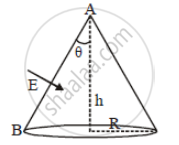
Find the magnitude of the flux that enters the cone's curved surface from the left side. Do not count the outgoing flux (θ < 45°)
Polar molecules are the molecules ______.
For a short dipole, the ratio of the electric field on the axial line to that on the equatorial line (at the same distance r) is:
The potential energy of a dipole in an external electric field is given by:
Water (H₂O) exhibits a dipole moment of approximately 1.85 D. The primary reason is:
