Advertisements
Advertisements
Question
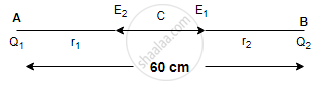
Two-point charges Q1 = 400 μC and Q2 = 100 μC are kept fixed, 60 cm apart in a vacuum. Find the intensity of the electric field at the midpoint of the line joining Q1 and Q2.
Advertisements
Solution
`"E"_1 = "Q"_1/(4 piin_0 "r"_1^2)` ... `["Q"_1 = 400mu"C" = 400 xx 10^-6"C"]`
`"E"_2 = "Q"_2/(4 piin_0 "r"_2^2)` ...`["Q"_2 = 100mu"C" = 100 xx 10^-6"C"]`
∴ The resultant electric field
E = E2 - E1
`= "Q"_2/(4 piin_0 "r"_2^2) - "Q"_1/(4 piin_0 "r"_1^2)`
`= 1/(4 piin_0 "r"^2) ... ["Q"_2 - "Q"_1][because "r"_1 = "r"_2 = "r"]`
`=(9 xx 10^9)/(30/100)^2 [400 - 100]xx10^-6`
`= (9xx10^11xx10^-6[3]xx100)/9`
`= 3 xx 10^7 "NC"^-1`
From Q1 to Q2
APPEARS IN
RELATED QUESTIONS
(i)Obtain the expression for the torque `vecτ` experienced by an electric dipole of dipole moment `vecP` in a uniform electric field, `vecE` .
(ii) What will happen if the field were not uniform?
Derive an expression for the intensity of electric field at a point in broadside position or on [4)
an equatorial line of an electric dipole.
- Define torque acting on a dipole of dipole moment \[\vec{p}\] placed in a uniform electric field \[\vec{E}\] Express it in the vector from and point out the direction along which it acts. Express it in the vector from and point out the direction along which it acts.
- What happens if the field is non-uniform?
- What would happen if the external field
\[\vec{E}\] is increasing (i) parallel to \[\vec{p}\] and (ii) anti-parallel to \[\vec{p}\]?
In which orientation, a dipole placed in a uniform electric field is in (i) stable, (ii) unstable equilibrium?
Two particles A and B, of opposite charges 2.0 × 10⁻⁶ C and −2.0 × 10⁻⁶ C, are placed at a separation of 1.0 cm. Calculate the electric field at a point on the axis of the dipole 1.0 cm away from the centre.
An electric dipole consists of two opposite charges each 0.05 µC separated by 30 mm. The dipole is placed in an unifom1 external electric field of 106 NC-1. The maximum torque exerted by the field on the dipole is ______
Electric dipole consists of two charges of magnitude 0.1 µC separated by a distance of 2 cm. The dipole is in 5 an external field of 105 N/C. What maximum torque does the field exert on the dipole?
Arrangement of an oxygen ion and two hydrogen ions in a water molecule is shown in the figure below.
Calculate the electric dipole moment of a water molecule. Express your answer in terms of e (charge on hydrogen ions), l and θ.

An electric dipole consists of charges +q and −q separated by a distance 2a. Which of the following statements about the dipole is correct?
The electric potential at a point P due to a dipole (at distance r from the centre, at angle θ from the dipole axis) is given by:
