Advertisements
Advertisements
Question
An electric dipole of length 2 cm, when placed with its axis making an angle of 60° with a uniform electric field, experiences a torque of \[8\sqrt{3}\] Nm. Calculate the potential energy of the dipole, if it has a charge \[\pm\] 4 nC.
Advertisements
Solution
Torque, \[\tau = \text { PE sin }\theta = \left( Ql \right)\text { E sin }\theta\] ........ (1)
Here, l is the length of the dipole, Q is the charge and E is the electric field.
Potential energy,
\[\text { U = - P Ecos }\theta = - \left( Ql \right)\text {Ecos}\theta\]
Dividing (2) by (1):
\[\frac{\tau}{U} = \frac{\left( Ql \right)E\sin\theta}{- \left( Ql \right)E\cos\theta} = - \tan\theta\]
\[ \Rightarrow U = - \frac{\tau}{\tan\theta}\]
\[ \Rightarrow U = - \frac{\tau}{\tan {60}^o}\]
\[ \Rightarrow U = - \frac{8\sqrt{3}}{\sqrt{3}}\]
\[ \Rightarrow U = - 8 J\]
APPEARS IN
RELATED QUESTIONS
A short electric dipole (which consists of two point charges, +q and -q) is placed at the centre 0 and inside a large cube (ABCDEFGH) of length L, as shown in Figure 1. The electric flux, emanating through the cube is:
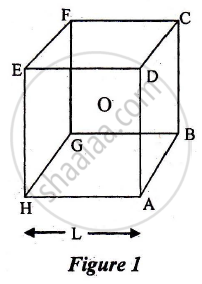
a) `q"/"4piin_9L`
b) zero
c) `q"/"2piin_0L`
d) `q"/"3piin_0L`
Write the expression for the torque \[\vec{\tau}\] acting on a dipole of dipole moment \[\vec{p}\] placed in an electric field \[\vec{E}\].
In a non-uniform electric field, electric dipole experiences:-
The electric field in a region is given by `vec"E" = 2/5"E"_0hat"i"+3/5"E"_0hat"j"` with `"E"_0 = 4.0xx10^3 "N"/"C"`. The flux of this field through a rectangular surface area 0.4 m2 parallel to the Y - Z plane is ______ Nm2C-1.
The direction of the dipole axis is defined as the line pointing from:
In the derivation of the electric field at the equatorial line, why do the components perpendicular to the dipole axis cancel out?
When a dipole is anti-aligned with the external electric field (θ = 180°), the potential energy is:
The electric potential at a point P due to a dipole (at distance r from the centre, at angle θ from the dipole axis) is given by:
Hydrogen chloride (HCl) has a large dipole moment because:
