Advertisements
Advertisements
Question
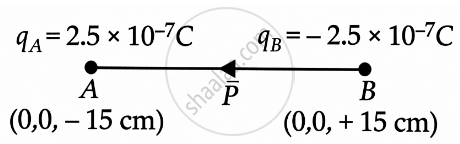
A system has two charges qA = 2.5 × 10⁻⁷ C and qB = −2.5 × 10⁻⁷ C located at points A: (0, 0, −15 cm) and B: (0, 0, +15 cm), respectively. What are the total charge and electric dipole moment of the system?
Advertisements
Solution
qnet = qA + qB
qnet = 2.5 × 10⁻⁷ + (−2.5 × 10⁻⁷)
= 2.5 × 10⁻⁷ − 2.5 × 10−7
= 0
Distance between two charges at points A and B,
d = 15 + 15
= 30 cm
= 0.3 m
The electric dipole moment of the system is given by,
= 2.5 × 10−7 × 0.3
= 7.5 × 10⁻⁸ C m directed along BA
RELATED QUESTIONS
An electric dipole of length 2 cm, when placed with its axis making an angle of 60° with a uniform electric field, experiences a torque of \[8\sqrt{3}\] Nm. Calculate the potential energy of the dipole, if it has a charge \[\pm\] 4 nC.
Define electric dipole moment. Is it a scalar or a vector? Derive the expression for the electric field of a dipole at a point on the equatorial plane of the dipole.
It is said that the separation between the two charges forming an electric dipole should be small. In comparison to what should this separation be small?
Two particles A and B, of opposite charges 2.0 × 10⁻⁶ C and −2.0 × 10⁻⁶ C, are placed at a separation of 1.0 cm.
Two particles, carrying charges −q and +q and and of mass m each, are fixed at the ends of a light rod of length a to form a dipole. The rod is clamped at an end and is placed in a uniform electric field E with the axis of the dipole along the electric field. The rod is slightly tilted and then released. Neglecting gravity, find the time period of small oscillations.
Answer the following question.
Derive an expression for the electric field at any point on the equatorial line of an electric dipole.
An electric dipole is placed at an angle of 30° with an electric field intensity of 2 × 10⁵ N/C. It experiences a torque equal to 4 Nm. The charge on the dipole, if the dipole length is 2 cm, is ______.
When an electric dipole p is placed in a uniform electric field E then at what angle the value of torque will be maximum?
Dimensions of mass in electric field and in electric dipole moment are respectively.
Electric field on the axis of a small electric dipole at a distance r is E1 and at a distance of 2r on its perpendicular bisector, the electric field is E2. Then the ratio E2: E1 is ______.
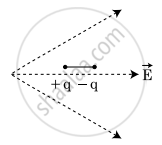
A dipole is placed in an electric field as shown. In which direction will it move?
The electric field in a region is given by `vec"E" = 2/5"E"_0hat"i"+3/5"E"_0hat"j"` with `"E"_0 = 4.0xx10^3 "N"/"C"`. The flux of this field through a rectangular surface area 0.4 m2 parallel to the Y - Z plane is ______ Nm2C-1.
Eight dipoles of charges of magnitude e each are placed inside a cube. The total electric flux coming out of the cube will be ______.
The midpoint of the line joining the negative and positive charges in an electric dipole is called the:
In the derivation of the electric field at the equatorial line, why do the components perpendicular to the dipole axis cancel out?
For a short dipole at a point P on the equatorial line, where r ≫ a, the electric field is given by:
The direction of the electric field on the equatorial line of a dipole is:
