Advertisements
Advertisements
प्रश्न
A system has two charges qA = 2.5 × 10⁻⁷ C and qB = −2.5 × 10⁻⁷ C located at points A: (0, 0, −15 cm) and B: (0, 0, +15 cm), respectively. What are the total charge and electric dipole moment of the system?
Advertisements
उत्तर
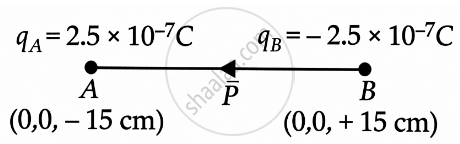
qnet = qA + qB
qnet = 2.5 × 10⁻⁷ + (−2.5 × 10⁻⁷)
= 2.5 × 10⁻⁷ − 2.5 × 10−7
= 0
Distance between two charges at points A and B,
d = 15 + 15
= 30 cm
= 0.3 m
The electric dipole moment of the system is given by,
= 2.5 × 10−7 × 0.3
= 7.5 × 10⁻⁸ C m directed along BA
संबंधित प्रश्न
(i)Obtain the expression for the torque `vecτ` experienced by an electric dipole of dipole moment `vecP` in a uniform electric field, `vecE` .
(ii) What will happen if the field were not uniform?
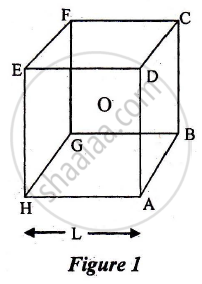
A short electric dipole (which consists of two point charges, +q and -q) is placed at the centre 0 and inside a large cube (ABCDEFGH) of length L, as shown in Figure 1. The electric flux, emanating through the cube is:
a) `q"/"4piin_9L`
b) zero
c) `q"/"2piin_0L`
d) `q"/"3piin_0L`
Derive an expression for the intensity of electric field at a point in broadside position or on [4)
an equatorial line of an electric dipole.
Define electric dipole moment. Is it a scalar or a vector? Derive the expression for the electric field of a dipole at a point on the equatorial plane of the dipole.
Define electric dipole moment.
It is said that the separation between the two charges forming an electric dipole should be small. In comparison to what should this separation be small?
Three charges are arranged on the vertices of an equilateral triangle, as shown in the figure. Find the dipole moment of the combination.
A uniform electric field is prevailing in X - direction in certain region. The coordinates of points P, Q, and R are (0, 0), (2, 0) and (0, 2) respectively. Which of the following alternatives is true for the potentials at these points?
An electric dipole is placed at an angle of 30° to a non-uniform electric field. The dipole will experience ________.
An electric dipole of moment p is placed parallel to the uniform electric field. The amount of work done in rotating the dipole by 90° is ____________.
The region surrounding a stationary electric dipole has ______
A dipole is placed in an electric field as shown. In which direction will it move?
The electric field in a region is given by `vec"E" = 2/5"E"_0hat"i"+3/5"E"_0hat"j"` with `"E"_0 = 4.0xx10^3 "N"/"C"`. The flux of this field through a rectangular surface area 0.4 m2 parallel to the Y - Z plane is ______ Nm2C-1.
The midpoint of the line joining the negative and positive charges in an electric dipole is called the:
The direction of the dipole axis is defined as the line pointing from:
Carbon dioxide (CO₂) has zero net dipole moment even though it contains polar C=O bonds. Why?
For the configuration with +0.25 μC at (0, 0, −15 cm) and −0.25 μC at (0, 0, +15 cm), the direction of the dipole moment is:
