Advertisements
Advertisements
प्रश्न
Derive an expression for the intensity of electric field at a point in broadside position or on [4)
an equatorial line of an electric dipole.
Advertisements
उत्तर
The electric field at a point, P due to an electric dipole.Due to the positive charge, the positive test charge will experience repulsive force whereas due to negative charge test charge will experience the attraction. Hence,

`|E_+| = 1/(4piin_0) q/(r^2 + a^2)`
`|E_-| = 1/(4piin_0) q/(r^2 + a^2)`
`E_R = E_+cos theta + E_- cos theta`
`= 1/(4piin_o) (2q)/(r^2 + a^2) . cos theta`
`= 1/(4piin_0) (2p)/(r^2 + a^2) . (q/(r^2 + a^2)^(1/2))`
`E_R = 1/()4piin_0 (2q xx a)/(r^2 + a^2)^(3/2) = 1/(4piin_0) p/(r^2 + a^2)^(3/2)`
if r >>> a, then
`E_R = 1/(4piin_0) p/r^3`
APPEARS IN
संबंधित प्रश्न
Define electric dipole moment. Is it a scalar or a vector? Derive the expression for the electric field of a dipole at a point on the equatorial plane of the dipole.
An electric dipole is placed in an electric field generated by a point charge.
Two particles A and B, of opposite charges 2.0 × 10⁻⁶ C and −2.0 × 10⁻⁶ C, are placed at a separation of 1.0 cm. Calculate the electric field at a point on the perpendicular bisector of the dipole and 1.0 m away from the centre.
A conic surface is placed in a uniform electric field E as shown in the figure such that the field is perpendicular to the surface on the side AB. The base of the cone is of radius R, and the height of the cone is h. The angle of the cone is θ.
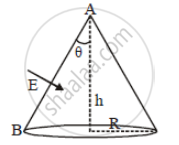
Find the magnitude of the flux that enters the cone's curved surface from the left side. Do not count the outgoing flux (θ < 45°)
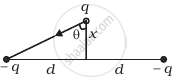
Two charges –q each are fixed separated by distance 2d. A third charge q of mass m placed at the mid-point is displaced slightly by x(x << d) perpendicular to the line joining the two fixed charged as shown in figure. Show that q will perform simple harmonic oscillation of time period.
`T = [(8pi^3 ε_0 md^3)/q^2]^(1/2)`
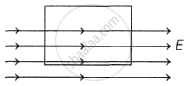
A square surface of side l (m) in the plane of the paper. A uniform electric field E(V/m) also in the plane of the paper is limited only to the lower half of the square surface, the electric flux (in SI units) associated with the surface is ______.
An electric dipole consists of charges +q and −q separated by a distance 2a. Which of the following statements about the dipole is correct?
The electric potential at a point P due to a dipole (at distance r from the centre, at angle θ from the dipole axis) is given by:
On the axial line of a dipole (θ = 0°), the electric potential is:
