Advertisements
Advertisements
प्रश्न
Answer the following question.
What is the unit of dipole moment?
Advertisements
उत्तर
- Strength of a dipole is measured in terms of a quantity called the dipole moment.
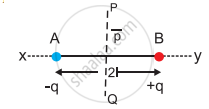
- Let q be the magnitude of each charge and `2vec"l"` be the distance from the negative charge to the positive charge. Then, the product `"q"(2vec"l")` is called the dipole moment `vec"p"`.
- Dipole moment is defined as `vec"p"="q"(2vec"l")`
- A dipole moment is a vector whose magnitude is q (2l) and the direction is from the negative to the positive charge.
- The unit of dipole moment is coulomb-meter (C m) or debye (D).
APPEARS IN
संबंधित प्रश्न
An electric dipole of length 4 cm, when placed with its axis making an angle of 60° with a uniform electric field, experiences a torque of `4sqrt3`Nm. Calculate the potential energy of the dipole, if it has charge ±8 nC
Derive an expression for the intensity of electric field at a point in broadside position or on [4)
an equatorial line of an electric dipole.
Write the expression for the torque \[\vec{\tau}\] acting on a dipole of dipole moment \[\vec{p}\] placed in an electric field \[\vec{E}\].
An electric dipole of length 2 cm, when placed with its axis making an angle of 60° with a uniform electric field, experiences a torque of \[8\sqrt{3}\] Nm. Calculate the potential energy of the dipole, if it has a charge \[\pm\] 4 nC.
An electric dipole of length 1 cm, which placed with its axis making an angle of 60° with uniform electric field, experience a torque of \[6\sqrt{3} Nm\] . Calculate the potential energy of the dipole if it has charge ±2 nC.
Define electric dipole moment.
Two particles A and B, of opposite charges 2.0 × 10⁻⁶ C and −2.0 × 10⁻⁶ C, are placed at a separation of 1.0 cm.
Two particles A and B, of opposite charges 2.0 × 10⁻⁶ C and −2.0 × 10⁻⁶ C, are placed at a separation of 1.0 cm. Calculate the electric field at a point on the axis of the dipole 1.0 cm away from the centre.
Three charges are arranged on the vertices of an equilateral triangle, as shown in the figure. Find the dipole moment of the combination.
In an electric dipole, at which point is the electric potential zero ?
A short electric dipole bas a dipole moment of 16 x 10-9 C m. The electric potential due to the dipole at a point at a distance of 0.6 m from the centre of the dipole, situated on a line making an angle of 60° with the dipole axis is: ____________. `(1/(4piepsilon_0) = 9 xx 10^9 "Nm"^2// "C"^2)`
The electric intensity due to a dipole of length 10 cm and having a charge of 500 µC, at a point on the axis at a distance 20 cm from one of the charges in air, is:
In a non-uniform electric field, electric dipole experiences:-
The region surrounding a stationary electric dipole has ______
Electric dipole consists of two charges of magnitude 0.1 µC separated by a distance of 2 cm. The dipole is in 5 an external field of 105 N/C. What maximum torque does the field exert on the dipole?
Polar molecules are the molecules ______.
A dipole is placed in an electric field as shown. In which direction will it move?

Polar molecules are the molecules ______.
The electric field in a region is given by `vec"E" = 2/5"E"_0hat"i"+3/5"E"_0hat"j"` with `"E"_0 = 4.0xx10^3 "N"/"C"`. The flux of this field through a rectangular surface area 0.4 m2 parallel to the Y - Z plane is ______ Nm2C-1.
A square surface of side l (m) in the plane of the paper. A uniform electric field E(V/m) also in the plane of the paper is limited only to the lower half of the square surface, the electric flux (in SI units) associated with the surface is ______.
The midpoint of the line joining the negative and positive charges in an electric dipole is called the:
Which line is defined as passing through the centre of a dipole and perpendicular to the dipole axis?
The electric dipole moment \[\vec{p}\] is defined mathematically as:
When a dipole is aligned with the external electric field (θ = 0°), the potential energy is:
On the axial line of a dipole (θ = 0°), the electric potential is:
On the equatorial line of a dipole (θ = 90°), the electric potential is:
How does the electric potential due to a dipole vary with distance compared to that of a point charge?
Hydrogen chloride (HCl) has a large dipole moment because:
