Advertisements
Advertisements
प्रश्न
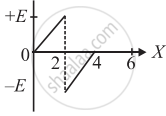
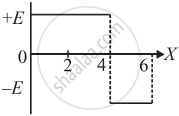
The electric potential V as a function of distance X is shown in the figure.
The graph of the magnitude of electric field intensity E as a function of X is ______.
विकल्प

Advertisements
उत्तर

APPEARS IN
संबंधित प्रश्न
Depict the orientation of the dipole in (i) stable, (ii) unstable equilibrium in a uniform electric field.
A conic surface is placed in a uniform electric field E as shown in the figure such that the field is perpendicular to the surface on the side AB. The base of the cone is of radius R, and the height of the cone is h. The angle of the cone is θ.
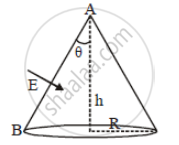
Find the magnitude of the flux that enters the cone's curved surface from the left side. Do not count the outgoing flux (θ < 45°)
The unit of electric dipole moment is ______.
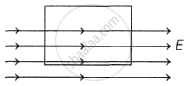
A square surface of side l (m) in the plane of the paper. A uniform electric field E(V/m) also in the plane of the paper is limited only to the lower half of the square surface, the electric flux (in SI units) associated with the surface is ______.
In an electric dipole, what is the locus of a point having zero potential?
Arrangement of an oxygen ion and two hydrogen ions in a water molecule is shown in the figure below.
Calculate the electric dipole moment of a water molecule. Express your answer in terms of e (charge on hydrogen ions), l and θ.

The direction of the dipole axis is defined as the line pointing from:
The electric dipole moment \[\vec{p}\] is defined mathematically as:
Hydrogen chloride (HCl) has a large dipole moment because:
