Advertisements
Advertisements
Question
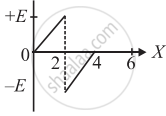
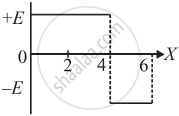
The electric potential V as a function of distance X is shown in the figure.
The graph of the magnitude of electric field intensity E as a function of X is ______.
Options

Advertisements
Solution

APPEARS IN
RELATED QUESTIONS
Depict the equipotential surfaces due to an electric dipole.
Derive an expression for the intensity of electric field at a point in broadside position or on [4)
an equatorial line of an electric dipole.
It is said that the separation between the two charges forming an electric dipole should be small. In comparison to what should this separation be small?
Three charges are arranged on the vertices of an equilateral triangle, as shown in the figure. Find the dipole moment of the combination.
Answer the following question.
Derive an expression for the electric field at any point on the equatorial line of an electric dipole.
Electric charges q, q, - 2q are placed at the comers of an equilateral triangle ABC of side l. The magnitude of electric dipole moment of the system is ____________.
Polar molecules are the molecules ______.
When a dipole is anti-aligned with the external electric field (θ = 180°), the potential energy is:
How does the electric potential due to a dipole vary with distance compared to that of a point charge?
