Advertisements
Advertisements
Question
If the reading of the voltmeter V1 is 40 V, then the reading of voltmeter V2 is ______.

Options
30 V
58 V
29 V
15 V
Advertisements
Solution
If the reading of the voltmeter V1 is 40 V, then the reading of voltmeter V2 is 30 V.
Explanation:
We know that
Vrms = `"V"_0/sqrt(2)`
= `(50sqrt(2))/sqrt(2)`
Vrms = 50
V2 = `sqrt("V"_("rms")^2 - "V"_1^2)`
= `sqrt((50)^2 - (40)^2)`
V2 = 30
APPEARS IN
RELATED QUESTIONS
A device 'X' is connected to an ac source V = V0 sin ωt. The variation of voltage, current and power in one cycle is shown in the following graph:
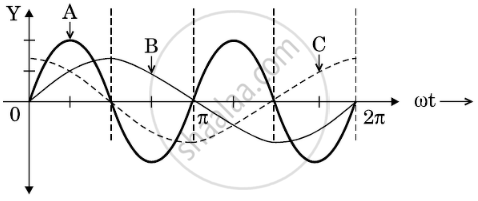
(a) Identify the device 'X'.
(b) Which of the curves A, B and C represent the voltage , current and the power consumed in the circuit? Justify your answer.
(c) How does its impedance vary with frequency of the ac source? Show graphically.
(d) Obtain an expression for the current in the circuit and its phase relation with ac voltage.
An alternative voltage given by V = 140 sin 314t is connected across a pure resistor of 50 Ω. Find
- The frequency of the source.
- The rms current is through the resistor.
If Vm and Im are peak voltage and current, impedance Z in an AC circuit is ______.
Can the instantaneous power output of an ac source ever be negative? Can the average power output be negative?
Using \[P_{\mathrm{loss}}=I^{2}R\], what reduces energy losses during transmission?
In a pure resistor AC circuit, how are the AC voltage source and resistor \[R\] connected?
In \[v=v_m\sin\omega t\], what does \[\omega\] represent?
What does Kirchhoff's Voltage Law give when the only element connected to the AC voltage source is resistor \[R\]?
Which notation identifies the RMS values of voltage and current?
What is the peak voltage of a \[220\,\mathrm{V}\] AC supply?
