Advertisements
Advertisements
Question
A 100 Ω resistor is connected to a 220 V, 50 Hz ac supply.
- What is the rms value of current in the circuit?
- What is the net power consumed over a full cycle?
Advertisements
Solution
Resistance of the resistor, R = 100 Ω
Supply voltage, V = 220 V
Frequency, v = 50 Hz
a. The r.m.s. value of the current in the circuit is given as:
`"I" = "V"/"R"`
= `220/100`
= 2.20 A
b. The net power consumed over a full cycle is given as:
P = VI
= 220 × 2.2
= 484 W
RELATED QUESTIONS
An alternative voltage given by V = 140 sin 314t is connected across a pure resistor of 50 Ω. Find
- The frequency of the source.
- The rms current is through the resistor.
A 100 Ω resistor is connected to a 220 V, 50 Hz ac supply.
What is the net power consumed over a full cycle?
Effective voltage Vrms is related to peak voltage Vo by ______.
If Vm and Im are peak voltage and current, impedance Z in an AC circuit is ______.
Study the circuits (a) and (b) shown in figure and answer the following questions.
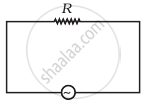 (a) |
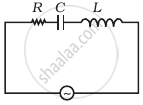 (b) |
- Under which conditions would the rms currents in the two circuits be the same?
- Can the rms current in circuit (b) be larger than that in (a)?
Can the instantaneous power output of an ac source ever be negative? Can the average power output be negative?
The alternating current in a circuit is described by the graph shown in figure. Show rms current in this graph.

If the reading of the voltmeter V1 is 40 V, then the reading of voltmeter V2 is ______.

When an AC voltage is applied to a pure resistor, the current and voltage are ______.
The standard household supply in India is 220 V. This value refers to ______.
The average power dissipated in a resistor when an AC current of peak value im flows through it is ______.
Using \[P_{\mathrm{loss}}=I^{2}R\], what reduces energy losses during transmission?
Which advantage do AC generators have over DC sources at a large scale?
In a pure resistor AC circuit, how are the AC voltage source and resistor \[R\] connected?
In \[v=v_m\sin\omega t\], what does \[v_m\] represent?
In \[v=v_m\sin\omega t\], what does \[\omega\] represent?
What does Kirchhoff's Voltage Law give when the only element connected to the AC voltage source is resistor \[R\]?
What results from substituting \[v=v_m\sin\omega t\] into \[v=iR\]?
How is peak current \[i_m\] related to peak voltage \[v_m\] in a pure resistor AC circuit?
What is the final current equation for a pure resistor AC circuit?
Which expression gives instantaneous power in a pure resistor AC circuit?
What physical effect makes an RMS value an equivalent “effective” value?
Which notation identifies the RMS values of voltage and current?
A light bulb is rated at \[100\,\mathrm{W}\] on a \[220\,\mathrm{V}\] AC supply. What is its resistance?
What is the peak voltage of a \[220\,\mathrm{V}\] AC supply?
