Advertisements
Advertisements
Question
Derive the expression for the electric potential due to an electric dipole at a point on its axial line.
Advertisements
Solution
i) Let P be the point at which electric potential is required.
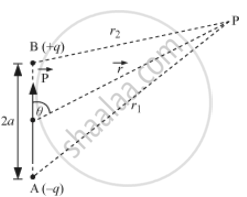
Potential at P due to − q charge,
`V_1=-q/(4piepsilon_0r_1)`
Potential at P due to + q charge,
`V_2=q/(4piepsilon_0r_2)`
Potential at P due to the dipole,
`V=V_1+V_2`
`V=q/(4piepsilon_0)[1/r_2-1/r_1]` .....(i)
Now, by geometry
`r_1^2=r^2+a^2+2arcostheta`
`r_2^2=r^2+a^2+2arcos(180^@-theta)`
`r_2^2=r^2+a^2-2arcostheta`
`r_1^2=r^2(1+a^2/r^2+(2a)/rcostheta)`
If r >> a, `a/r` is small. Therefore,`a^2/r^2` can be neglected.
`r_1^2=r^2(1+(2a)/rcostheta)`
`1/r_1=1/r(1+(2a)/rcostheta)^(1/2)`
similarly, `1/r_2=1/r(1-(2a)/rcostheta)^(1/2)`
Putting these values in (i), we obtain
`V=q/(4piepsilon_0)[1/r(1-(2a)/rcostheta)^(1/2)-1/r(1+(2a)/rcostheta)^(1/2)]`
Using Binomial theorem and retaining terms up to the first order in`a/r`, we obtain
`V=q/(4piepsilon_0r)[1+a/rcostheta-(1-a/rcostheta)]`
`V=q/(4piepsilon_0r)[1+a/rcostheta-1+a/rcostheta]`
`V=q/(4piepsilon_0r)[(2a)/rcostheta]`
`V=(qxx2acostheta)/(4piepsilon_0r^2)`
`V=(Pcostheta)/(4piepsilon_0r^2)`
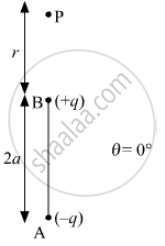
For axial line put θ=0°
`V=(Pcos(0))/(4piepsilon_0r^2)`
`V=P/(4piepsilon_0r^2)`
APPEARS IN
RELATED QUESTIONS
An electric dipole of length 1 cm, which placed with its axis making an angle of 60° with uniform electric field, experience a torque of \[6\sqrt{3} Nm\] . Calculate the potential energy of the dipole if it has charge ±2 nC.
Define electric dipole moment.
Answer the following question.
What is the unit of dipole moment?
A uniform electric field is prevailing in X - direction in certain region. The coordinates of points P, Q, and R are (0, 0), (2, 0) and (0, 2) respectively. Which of the following alternatives is true for the potentials at these points?
Dimensions of mass in electric field and in electric dipole moment are respectively.
The electric field at a point on the equatorial plane at a distance r from the centre of a dipole having dipole moment `vec "p"` is given by, (r >> separation of two charges forming the dipole, `epsilon_0 - ` permittivity of free space) ____________.
An electric dipole of moment `vec"p"` is placed normal to the lines of force of electric intensity `vec"E"`, then the work done in deflecting it through an angle of 180° is:
In a non-uniform electric field, electric dipole experiences:-
For a short dipole, the ratio of the electric field on the axial line to that on the equatorial line (at the same distance r) is:
