Advertisements
Advertisements
Question
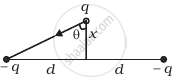
Two charges –q each are fixed separated by distance 2d. A third charge q of mass m placed at the mid-point is displaced slightly by x(x << d) perpendicular to the line joining the two fixed charged as shown in figure. Show that q will perform simple harmonic oscillation of time period.
`T = [(8pi^3 ε_0 md^3)/q^2]^(1/2)`
Advertisements
Solution
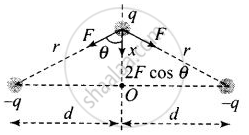
Let the charge q is displaced slightly by x(x << d) perpendicular to the line joining the two fixed charges. Net force on the charge q will be towards O. The motion of charge q to be simple harmonic, if the force on charge q must be proportional to its distance from the centre O and is directed towards O.
Net force on the charge Fnet = 2F cos θ
Here F = `1/(4piε_0) (q(q))/r^2 = 1/(4piε_0) q^2/((d^2 + x^2))`
And cos θ = `x/sqrt(x^2 + d^2)`
Hence, Fnet = `2[1/(4piε_0) q^2/((d^2 + x^2))][x/sqrt(x^2 + d^2)]`
= `1/(2piε_0) (q^2x)/(d^2 + x^2)^(3/2)`
= `1/(2piε_0) (q^2x)/(d^3 (1 + x^2/d^2)^(3/2)`
As x << d, then Fnet = `1/(2piε_0) (q^2x)/d^3` or Fnet = Kx
i.e., force on charge q is proportional to its displacement from the centre O and it is directed towards O. Hence, motion of charge q would be simple harmonic, where ω = `sqrt(K/m)`
And T = `(2pi)/ω = 2pi sqrt(m/K)`
⇒ T = `2pi sqrt((m * 4piε_0 d^3)/(2q^2)) = [(8pi^3ε_0 md^3)/q^2]^(1/2)`
APPEARS IN
RELATED QUESTIONS
Drive the expression for electric field at a point on the equatorial line of an electric dipole.
An electric dipole of length 2 cm, when placed with its axis making an angle of 60° with a uniform electric field, experiences a torque of \[8\sqrt{3}\] Nm. Calculate the potential energy of the dipole, if it has a charge \[\pm\] 4 nC.
Define dipole moment of an electric dipole. Is it a scalar or a vector?
An electric dipole is placed in an electric field generated by a point charge.
Two-point charges Q1 = 400 μC and Q2 = 100 μC are kept fixed, 60 cm apart in a vacuum. Find the intensity of the electric field at the midpoint of the line joining Q1 and Q2.
An electric dipole consists of two opposite charges each 0.05 µC separated by 30 mm. The dipole is placed in an unifom1 external electric field of 106 NC-1. The maximum torque exerted by the field on the dipole is ______
A uniform electric field is prevailing in X - direction in certain region. The coordinates of points P, Q, and R are (0, 0), (2, 0) and (0, 2) respectively. Which of the following alternatives is true for the potentials at these points?
A metal sphere of radius 1 cm is given a charge of 3.14 µC. Find the electric intensity at a distance of 1 m from the centre of sphere.
`[epsilon_0 = 8.85 xx 10^-12 "F"//m]`
Electric charges q, q, - 2q are placed at the comers of an equilateral triangle ABC of side l. The magnitude of electric dipole moment of the system is ____________.
An electric dipole is placed at an angle of 30° to a non-uniform electric field. The dipole will experience ________.
In a non-uniform electric field, electric dipole experiences:-
Electric dipole consists of two charges of magnitude 0.1 µC separated by a distance of 2 cm. The dipole is in 5 an external field of 105 N/C. What maximum torque does the field exert on the dipole?
Polar molecules are the molecules ______.
Arrangement of an oxygen ion and two hydrogen ions in a water molecule is shown in the figure below.
Calculate the electric dipole moment of a water molecule. Express your answer in terms of e (charge on hydrogen ions), l and θ.

The electric dipole moment \[\vec{p}\] is defined mathematically as:
In the derivation of the electric field at the equatorial line, why do the components perpendicular to the dipole axis cancel out?
The potential energy of a dipole in an external electric field is given by:
When a dipole is anti-aligned with the external electric field (θ = 180°), the potential energy is:
