Advertisements
Advertisements
Question
A sample of HCI gas is placed in an electric field of 2.5 × 10⁴ NC−1. The dipole moment of each HCI molecule is 3.4 × 10⁻³⁰ Cm. Find the maximum torque that can act on a molecule.
Advertisements
Solution
Given:
Electric field intensity, E = 2.5 × 10⁴ NC−1
Dipole moment of an HCl molecule, P = 3.4 × 10⁻³⁰ Cm
Torque on the molecule,
\[\Gamma = PE\sin\theta\]
For
\[ = 3 . 4 \times {10}^{- 30} 2 . 5 \times {10}^4 \]
\[ = 8 . 5 \times {10}^{- 26} \] Nm
APPEARS IN
RELATED QUESTIONS
Derive the expression for the electric potential due to an electric dipole at a point on its axial line.
Write the expression for the torque \[\vec{\tau}\] acting on a dipole of dipole moment \[\vec{p}\] placed in an electric field \[\vec{E}\].
An electric dipole of length 2 cm, when placed with its axis making an angle of 60° with a uniform electric field, experiences a torque of \[8\sqrt{3}\] Nm. Calculate the potential energy of the dipole, if it has a charge \[\pm\] 4 nC.
An electric dipole is placed at the centre of a sphere. Mark the correct options.
(a) The flux of the electric field through the sphere is zero.
(b) The electric field is zero at every point of the sphere.
(c) The electric field is not zero anywhere on the sphere.
(d) The electric field is zero on a circle on the sphere.
Answer the following question.
Derive an expression for the electric field at any point on the equatorial line of an electric dipole.
A uniform electric field is prevailing in X - direction in certain region. The coordinates of points P, Q, and R are (0, 0), (2, 0) and (0, 2) respectively. Which of the following alternatives is true for the potentials at these points?
On the axis and on the equator of an electric dipole for all points ____________.
The ratio of the weight of a man in a stationary lift and in a lift accelerating downwards with a uniform acceleration α is 3 : 2. The acceleration of the lift is:
The electric intensity due to a dipole of length 10 cm and having a charge of 500 µC, at a point on the axis at a distance 20 cm from one of the charges in air, is:
Electric dipole consists of two charges of magnitude 0.1 µC separated by a distance of 2 cm. The dipole is in 5 an external field of 105 N/C. What maximum torque does the field exert on the dipole?
Polar molecules are the molecules ______.
Polar molecules are the molecules ______.
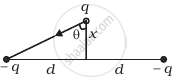
Two charges –q each are fixed separated by distance 2d. A third charge q of mass m placed at the mid-point is displaced slightly by x(x << d) perpendicular to the line joining the two fixed charged as shown in figure. Show that q will perform simple harmonic oscillation of time period.
`T = [(8pi^3 ε_0 md^3)/q^2]^(1/2)`
Eight dipoles of charges of magnitude e each are placed inside a cube. The total electric flux coming out of the cube will be ______.
For a short dipole, the ratio of the electric field on the axial line to that on the equatorial line (at the same distance r) is:
When a dipole is aligned with the external electric field (θ = 0°), the potential energy is:
Hydrogen chloride (HCl) has a large dipole moment because:
Carbon dioxide (CO₂) has zero net dipole moment even though it contains polar C=O bonds. Why?
A configuration consists of charges +q, −2q, and +q at the vertices of an equilateral triangle with side length 2l. Treating this as a combination of two dipoles, what is the net dipole moment?
