Advertisements
Advertisements
प्रश्न
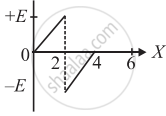
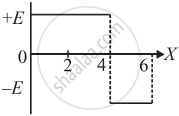
The electric potential V as a function of distance X is shown in the figure.
The graph of the magnitude of electric field intensity E as a function of X is ______.
पर्याय

Advertisements
उत्तर

APPEARS IN
संबंधित प्रश्न
Depict the orientation of the dipole in (i) stable, (ii) unstable equilibrium in a uniform electric field.
An electric dipole is placed at an angle of 30° with an electric field intensity of 2 × 10⁵ N/C. It experiences a torque equal to 4 Nm. The charge on the dipole, if the dipole length is 2 cm, is ______.
Dimensions of mass in electric field and in electric dipole moment are respectively.
Electric dipole consists of two charges of magnitude 0.1 µC separated by a distance of 2 cm. The dipole is in 5 an external field of 105 N/C. What maximum torque does the field exert on the dipole?
Arrangement of an oxygen ion and two hydrogen ions in a water molecule is shown in the figure below.
Calculate the electric dipole moment of a water molecule. Express your answer in terms of e (charge on hydrogen ions), l and θ.

Which line is defined as passing through the centre of a dipole and perpendicular to the dipole axis?
When a dipole is aligned with the external electric field (θ = 0°), the potential energy is:
A dipole is perpendicular to an external electric field (θ = 90°). What are the torque and potential energy?
On the axial line of a dipole (θ = 0°), the electric potential is:
Water (H₂O) exhibits a dipole moment of approximately 1.85 D. The primary reason is:
