Advertisements
Advertisements
प्रश्न
Answer the following question.
Derive an expression for the electric field at any point on the equatorial line of an electric dipole.
Advertisements
उत्तर
Electric field for points on the equator plane
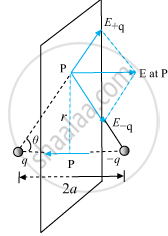
The magnitude of the electric field due to two charges +q and –q is
`E_(+q) = q/(4piε_0)1/(r^2 + a^2)`
`E_(-q) = q/(4piε_0)1/(r^2 + a^2)`
`E_(+q) = E_(-q)`
The directions of `E_(+q) and E_(-q)`, are as shown in the figure. The components normal to the dipole axis cancel away. The components along the dipole axis add up.
Total electric field, `E = -(E_(+q) + E_(-q)) costheta hatp` ......(Negative sign shows that the field is opposite to `hatp`)
`E = -(2qa)/(4piε_0(r^2 + a^2)^(3/2))hatp` ...(iii)
At large distance (r >> a), this reduces to,
`E = -(2qa)/(4piε_0r^3)hatp`
`vecp = q xx 2vecahatp`
`E = -vecp/(4piε_0r^3)` ....(r >> a)
संबंधित प्रश्न
An electric dipole of length 4 cm, when placed with its axis making an angle of 60° with a uniform electric field, experiences a torque of `4sqrt3`Nm. Calculate the potential energy of the dipole, if it has charge ±8 nC
A system has two charges qA = 2.5 × 10⁻⁷ C and qB = −2.5 × 10⁻⁷ C located at points A: (0, 0, −15 cm) and B: (0, 0, +15 cm), respectively. What are the total charge and electric dipole moment of the system?
An electric dipole of length 1 cm, which placed with its axis making an angle of 60° with uniform electric field, experience a torque of \[6\sqrt{3} Nm\] . Calculate the potential energy of the dipole if it has charge ±2 nC.
A sample of HCI gas is placed in an electric field of 2.5 × 10⁴ NC−1. The dipole moment of each HCI molecule is 3.4 × 10⁻³⁰ Cm. Find the maximum torque that can act on a molecule.
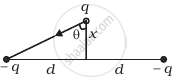
Two charges –q each are fixed separated by distance 2d. A third charge q of mass m placed at the mid-point is displaced slightly by x(x << d) perpendicular to the line joining the two fixed charged as shown in figure. Show that q will perform simple harmonic oscillation of time period.
`T = [(8pi^3 ε_0 md^3)/q^2]^(1/2)`
In an electric dipole, what is the locus of a point having zero potential?
An electric dipole consists of charges +q and −q separated by a distance 2a. Which of the following statements about the dipole is correct?
For a short dipole, the ratio of the electric field on the axial line to that on the equatorial line (at the same distance r) is:
Water (H₂O) exhibits a dipole moment of approximately 1.85 D. The primary reason is:
For the configuration with +0.25 μC at (0, 0, −15 cm) and −0.25 μC at (0, 0, +15 cm), the direction of the dipole moment is:
