Advertisements
Advertisements
प्रश्न
Two identical point charges, q each, are kept 2m apart in the air. A third point charge Q of unknown magnitude and sign is placed on the line joining the charges such that the system remains in equilibrium. Find the position and nature of Q.
Advertisements
उत्तर
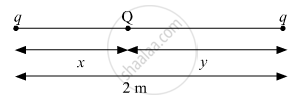
`(K(q)(Q))/x = (-K(q)(q))/2`
⇒ Q = `(-qx)/2`
∵ `(KqQ)/x = (KQq)/y`
x = y
x + y = 2
∴ x = y = 1
Q = `(-q)/2`
संबंधित प्रश्न
Draw a sketch of equipotential surfaces due to a single charge (-q), depicting the electric field lines due to the charge
Draw the equipotential surfaces due to an electric dipole. Locate the points where the potential due to the dipole is zero.
Depict the equipotential surfaces for a system of two identical positive point charges placed a distance(d) apart?
Draw the equipotential surfaces due to an electric dipole.
Find the amount of work done in rotating an electric dipole of dipole moment 3.2 x 10- 8Cm from its position of stable equilibrium to the position of unstable equilibrium in a uniform electric field if intensity 104 N/C.
A particle of mass 'm' having charge 'q' is held at rest in uniform electric field of intensity 'E'. When it is released, the kinetic energy attained by it after covering a distance 'y' will be ______.
Which of the following is NOT the property of equipotential surface?
What is meant by an equipotential surface?
A curve connecting points that all have equal electric potential is best described as:
The direction in which electric potential decreases is:
