Advertisements
Advertisements
प्रश्न
Depict the equipotential surface due to
(i) an electric dipole,
(ii) two identical positive charges separated by a distance.
Advertisements
उत्तर
Equipotential surfaces for (a) a dipole and (b) two identical positive charges are shown in Figure.
Notes


Some equipotential surfaces for (a) a dipole, (b) two identical positive charges.
APPEARS IN
संबंधित प्रश्न
A particle of mass 'm' having charge 'q' is held at rest in uniform electric field of intensity 'E'. When it is released, the kinetic energy attained by it after covering a distance 'y' will be ______.
Equipotentials at a great distance from a collection of charges whose total sum is not zero are approximately.
The diagrams below show regions of equipotentials.
(i)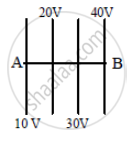 |
(ii) |
(iii) |
(iv) |
A positive charge is moved from A to B in each diagram.
- The potential at all the points on an equipotential surface is same.
- Equipotential surfaces never intersect each other.
- Work done in moving a charge from one point to other on an equipotential surface is zero.
Equipotential surfaces ______.
Can two equipotential surfaces intersect each other?
Prove that a closed equipotential surface with no charge within itself must enclose an equipotential volume.
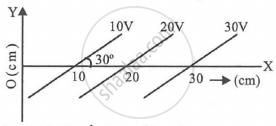
Equipotential surfaces are shown in figure. Then the electric field strength will be ______.
What is meant by an equipotential surface?
In a uniform electric field, the equipotential surfaces take the shape of:
