Advertisements
Advertisements
प्रश्न
What is the geometrical shape of equipotential surfaces due to a single isolated charge?
Advertisements
उत्तर
For an isolated charge the equipotential surfaces are co-centric spherical shells and the distance between the shells increases with the decrease in electric field.
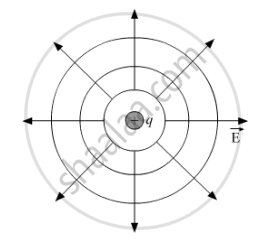
APPEARS IN
संबंधित प्रश्न
Define an equipotential surface.
Two charges 2 μC and −2 µC are placed at points A and B 6 cm apart.
- Identify an equipotential surface of the system.
- What is the direction of the electric field at every point on this surface?
A man fixes outside his house one evening a two metre high insulating slab carrying on its top a large aluminium sheet of area 1 m2. Will he get an electric shock if he touches the metal sheet next morning?
Draw equipotential surfaces:
(1) in the case of a single point charge and
(2) in a constant electric field in Z-direction. Why are the equipotential surfaces about a single charge not equidistant?
(3) Can electric field exist tangential to an equipotential surface? Give reason
Why is there no work done in moving a charge from one point to another on an equipotential surface?
Statement - 1: For practical purpose, the earth is used as a reference at zero potential in electrical circuits.
Statement - 2: The electrical potential of a sphere of radius R with charge Q uniformly distributed on the surface is given by `Q/(4piepsilon_0R)`.
Consider the following statements and select the correct statement(s).
- Electric field lines are always perpendicular to equipotential surface.
- No two equipotential surfaces can intersect each other.
- Electric field lines are in the direction of tangent to an equipotential surface.
Find the equation of the equipotentials for an infinite cylinder of radius r0, carrying charge of linear density λ.
The surface of any conductor in electrostatic equilibrium is an equipotential surface because:
For an electric dipole (+q, −q), the equipotential surfaces are best described as:
