Advertisements
Advertisements
प्रश्न
Depict the equipotential surface due to
(i) an electric dipole,
(ii) two identical positive charges separated by a distance.
Advertisements
उत्तर
Equipotential surfaces for (a) a dipole and (b) two identical positive charges are shown in Figure.
Notes


Some equipotential surfaces for (a) a dipole, (b) two identical positive charges.
APPEARS IN
संबंधित प्रश्न
Describe schematically the equipotential surfaces corresponding to
(a) a constant electric field in the z-direction,
(b) a field that uniformly increases in magnitude but remains in a constant (say, z) direction,
(c) a single positive charge at the origin, and
(d) a uniform grid consisting of long equally spaced parallel charged wires in a plane.
Draw the equipotential surfaces due to an electric dipole. Locate the points where the potential due to the dipole is zero.
Depict the equipotential surfaces for a system of two identical positive point charges placed a distance(d) apart?
Statement - 1: For practical purpose, the earth is used as a reference at zero potential in electrical circuits.
Statement - 2: The electrical potential of a sphere of radius R with charge Q uniformly distributed on the surface is given by `Q/(4piepsilon_0R)`.
Equipotential surfaces ______.
Which of the following is NOT the property of equipotential surface?
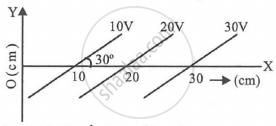
Equipotential surfaces are shown in figure. Then the electric field strength will be ______.
If the electric field \[\vec{E}\] had a component along (tangent to) an equipotential surface, what contradiction would arise?
The direction in which electric potential decreases is:
In the derivation proving \[\vec{E}\] is perpendicular to an equipotential surface, a charge \[q_0\] undergoes a small displacement \[d\vec{l}\] along the surface, with \[\vec{E}\] making an angle \[\theta\] with the displacement. Equating the work expressions leads to which conclusion?
