Advertisements
Advertisements
प्रश्न
Draw equipotential surfaces:
(1) in the case of a single point charge and
(2) in a constant electric field in Z-direction. Why are the equipotential surfaces about a single charge not equidistant?
(3) Can electric field exist tangential to an equipotential surface? Give reason
Advertisements
उत्तर
(1)

(2)
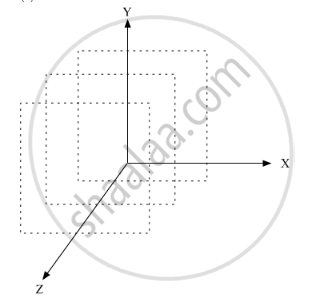
The equipotential surfaces about a single charge are not equidistant because electric field due to a single change is not constant.
(3) If the electric field exist along tangential to an equipotential surface, a charged particle will experience a force along the tangential line and can move along it. As a charged particle can move only due to the potential difference (along with the direction of change of potential), this contradicts the concept of an equipotential surface.
APPEARS IN
संबंधित प्रश्न
Draw a sketch of equipotential surfaces due to a single charge (-q), depicting the electric field lines due to the charge
Two charges 2 μC and −2 µC are placed at points A and B 6 cm apart.
- Identify an equipotential surface of the system.
- What is the direction of the electric field at every point on this surface?
The discharging current in the atmosphere due to the small conductivity of air is known to be 1800 A on an average over the globe. Why then does the atmosphere not discharge itself completely in due course and become electrically neutral? In other words, what keeps the atmosphere charged?
Assertion: Electric field is discontinuous across the surface of a spherical charged shell.
Reason: Electric potential is continuous across the surface of a spherical charged shell.
Can two equipotential surfaces intersect each other?
Consider a uniform electric field in the ẑ direction. The potential is a constant ______.
- in all space.
- for any x for a given z.
- for any y for a given z.
- on the x-y plane for a given z.
What is an equipotential surface?
A curve connecting points that all have equal electric potential is best described as:
Equipotential surfaces are denser (closer together) in regions where:
The relation between the electric field \[\vec{E}\] and the potential gradient is expressed as:
