Advertisements
Advertisements
प्रश्न
Draw equipotential surfaces:
(1) in the case of a single point charge and
(2) in a constant electric field in Z-direction. Why are the equipotential surfaces about a single charge not equidistant?
(3) Can electric field exist tangential to an equipotential surface? Give reason
Advertisements
उत्तर
(1)

(2)
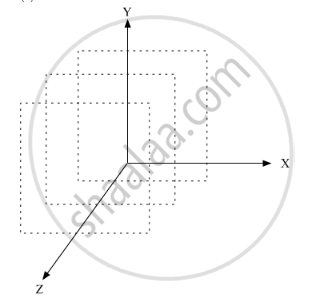
The equipotential surfaces about a single charge are not equidistant because electric field due to a single change is not constant.
(3) If the electric field exist along tangential to an equipotential surface, a charged particle will experience a force along the tangential line and can move along it. As a charged particle can move only due to the potential difference (along with the direction of change of potential), this contradicts the concept of an equipotential surface.
APPEARS IN
संबंधित प्रश्न
Draw a sketch of equipotential surfaces due to a single charge (-q), depicting the electric field lines due to the charge
Describe schematically the equipotential surfaces corresponding to
(a) a constant electric field in the z-direction,
(b) a field that uniformly increases in magnitude but remains in a constant (say, z) direction,
(c) a single positive charge at the origin, and
(d) a uniform grid consisting of long equally spaced parallel charged wires in a plane.
Depict the equipotential surface due to
(i) an electric dipole,
(ii) two identical positive charges separated by a distance.
- The potential at all the points on an equipotential surface is same.
- Equipotential surfaces never intersect each other.
- Work done in moving a charge from one point to other on an equipotential surface is zero.
Can two equipotential surfaces intersect each other?
A charge \[q_0\] is moved from point A to point B on the same equipotential surface. If the potentials at A and B are \[V_A\] and \[V_B\] respectively, the work done is:
If the electric field \[\vec{E}\] had a component along (tangent to) an equipotential surface, what contradiction would arise?
A point charge of \[1\ \mu\text{C}\] produces a potential \[V = \frac{kq}{r}\]. At what distance from the charge does the potential equal 90 V? (Take \[k = 9 \times 10^9\ \text{N m}^2/\text{C}^2\])
