Advertisements
Advertisements
प्रश्न
The discharging current in the atmosphere due to the small conductivity of air is known to be 1800 A on an average over the globe. Why then does the atmosphere not discharge itself completely in due course and become electrically neutral? In other words, what keeps the atmosphere charged?
Advertisements
उत्तर
The occurrence of thunderstorms and lightning charges the atmosphere continuously. Hence, even with the presence of discharging current of 1800 A, the atmosphere is not discharged completely. The two opposing currents are in equilibrium and the atmosphere remains electrically neutral.
APPEARS IN
संबंधित प्रश्न
Draw a sketch of equipotential surfaces due to a single charge (-q), depicting the electric field lines due to the charge
A regular hexagon of side 10 cm has a charge 5 µC at each of its vertices. Calculate the potential at the centre of the hexagon.
Draw equipotential surfaces:
(1) in the case of a single point charge and
(2) in a constant electric field in Z-direction. Why are the equipotential surfaces about a single charge not equidistant?
(3) Can electric field exist tangential to an equipotential surface? Give reason
Draw the equipotential surfaces due to an electric dipole. Locate the points where the potential due to the dipole is zero.
Find the amount of work done in rotating an electric dipole of dipole moment 3.2 x 10- 8Cm from its position of stable equilibrium to the position of unstable equilibrium in a uniform electric field if intensity 104 N/C.
S1 and S2 are the two imaginary surfaces enclosing the charges +q and -q as shown. The electric flux through S1 and S2 are respectively ______.
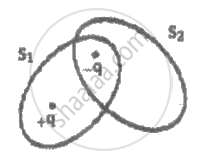
Assertion: Electric field is discontinuous across the surface of a spherical charged shell.
Reason: Electric potential is continuous across the surface of a spherical charged shell.
Consider the following statements and select the correct statement(s).
- Electric field lines are always perpendicular to equipotential surface.
- No two equipotential surfaces can intersect each other.
- Electric field lines are in the direction of tangent to an equipotential surface.
Equipotentials at a great distance from a collection of charges whose total sum is not zero are approximately.
Equipotential surfaces ______.
Can two equipotential surfaces intersect each other?
Find the equation of the equipotentials for an infinite cylinder of radius r0, carrying charge of linear density λ.
Draw equipotential surfaces for (i) an electric dipole and (ii) two identical positive charges placed near each other.
A curve connecting points that all have equal electric potential is best described as:
In the derivation proving \[\vec{E}\] is perpendicular to an equipotential surface, a charge \[q_0\] undergoes a small displacement \[d\vec{l}\] along the surface, with \[\vec{E}\] making an angle \[\theta\] with the displacement. Equating the work expressions leads to which conclusion?
The relation between the electric field \[\vec{E}\] and the potential gradient is expressed as:
