Advertisements
Advertisements
प्रश्न
Draw the equipotential surfaces due to an electric dipole.
Advertisements
उत्तर

APPEARS IN
संबंधित प्रश्न
A regular hexagon of side 10 cm has a charge 5 µC at each of its vertices. Calculate the potential at the centre of the hexagon.
What are the forms of energy into which the electrical energy of the atmosphere is dissipated during a lightning?
(Hint: The earth has an electric field of about 100 Vm−1 at its surface in the downward direction, corresponding to a surface charge density = −10−9 C m−2. Due to the slight conductivity of the atmosphere up to about 50 km (beyond which it is good conductor), about + 1800 C is pumped every second into the earth as a whole. The earth, however, does not get discharged since thunderstorms and lightning occurring continually all over the globe pump an equal amount of negative charge on the earth.)
A particle of mass 'm' having charge 'q' is held at rest in uniform electric field of intensity 'E'. When it is released, the kinetic energy attained by it after covering a distance 'y' will be ______.
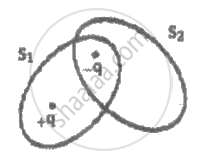
S1 and S2 are the two imaginary surfaces enclosing the charges +q and -q as shown. The electric flux through S1 and S2 are respectively ______.
The diagrams below show regions of equipotentials.
(i)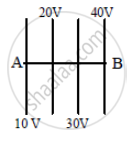 |
(ii) |
(iii) |
(iv)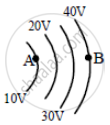 |
A positive charge is moved from A to B in each diagram.
Equipotential surfaces ______.
- are closer in regions of large electric fields compared to regions of lower electric fields.
- will be more crowded near sharp edges of a conductor.
- will be more crowded near regions of large charge densities.
- will always be equally spaced.
Draw equipotential surfaces for (i) an electric dipole and (ii) two identical positive charges placed near each other.
What is an equipotential surface?
A curve connecting points that all have equal electric potential is best described as:
The direction in which electric potential decreases is:
