Advertisements
Advertisements
प्रश्न
Answer the following question.
Derive an expression for the electric field due to a dipole of dipole moment `vec"p"` at a point on its perpendicular bisector.
Advertisements
उत्तर
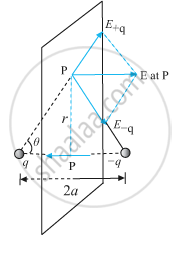
The magnitudes of the electric field due to the two charges +q and −q are given by,
`E_(+q) = ("q")/(4πε_0) (1)/("r"^2 + a^2)` .....(i)
`E_(-q) = ("q")/(4πε_0) (1)/("r"^2 + a^2)` .....(i)
∴ `E_(+q) = E_(-q)`
The directions of E+q and E−q are as shown in the figure. The components normal to the dipole axis cancel away. The components along the dipole axis add up.
∴ Total electric field
`E = -(E_+q + E_-q) cos theta hat"p" ... ["negative sign shows that field is opposite to" hat"p"]`
`E = -(2qa)/(4πε_0("r"^2 + a^2)^(3/2)) hat"p"` ....(iii)
At large distances (r >> a), this reduces to
`E = -(2qa)/(4πε_0"r"^3)hat"p"` ....(iv)
∵ `vec"p" = q xx vec"2a"hat"p"`
∴ `E = (-vec"p")/(4πε_0"r"^3)` ...(r>>a).
APPEARS IN
संबंधित प्रश्न
Why do the electric field lines never cross each other?
A point charge (+Q) is kept in the vicinity of an uncharged conducting plate. Sketch the electric field lines between the charge and the plate?
Two bar magnets are quickly moved towards a metallic loop connected across a capacitor ‘C’ as shown in the figure. Predict the polarity of the capacitor.

Answer the following question.
Draw the pattern of electric field lines when a point charge +q is kept near an uncharged conducting plate.
Explain why two field lines never cross each other at any point?
If Ea be the electric field strength of a short dipole at a point on its axial line and Ee that on the equatorial line at the same distance, then:
In figure, two positive charges q2 and q3 fixed along the y axis, exert a net electric force in the + x direction on a charge q1 fixed along the x-axis. If a positive charge Q is added at (x, 0), the force on q1
![]() (a) |
![]() (b) |
Figure shows the electric field lines around three point charges A, B and C.

- Which charges are positive?
- Which charge has the largest magnitude? Why?
- In which region or regions of the picture could the electric field be zero? Justify your answer.
(i) near A, (ii) near B, (iii) near C, (iv) nowhere.


