Advertisements
Advertisements
प्रश्न
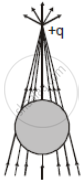
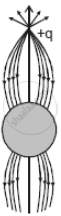
A point positive charge is brought near an isolated conducting sphere (figure). The electric field is best given by ______.
पर्याय
Advertisements
उत्तर
Explanation:
• Electric field lines come out of the positive charge and go into the negative charge.
• Tangent to the field line at any point gives the direction of the field at that point.
• Field lines are always normal to the conducting surface.
• Field lines do not exist inside a conductor.
The explanation to this problem can be done by keeping two things in mind.
- Concept of induction
- The electric field lines interact with a conducting body normally.
Let us discuss the phenomenon of induction involved in this case. When a positive point charge is brought near an isolated conducting sphere without touching the sphere, then the free electrons in the sphere are attracted toward the positive charge. Thus, the left surface of sphere has an excess of negative charge and the right surface of sphere has an excess of positive charge. It should be noted that both kinds of charges are bound in the metal sphere and cannot escape. They, therefore, reside on the surface of the sphere.

An electric field lines start from a positive point charge and ends at a negative charge induced on the left surface of sphere. Also, electric field line emerges from a positive charge, in case of a single charge and ends at infinity.
Here, all these conditions are fulfilled in Figure.
APPEARS IN
संबंधित प्रश्न
(a) Derive an expression for the electric field E due to a dipole of length '2a' at a point distant r from the centre of the dipole on the axial line.
(b) Draw a graph of E versus r for r >> a.
(c) If this dipole were kept in a uniform external electric field E0, diagrammatically represent the position of the dipole in stable and unstable equilibrium and write the expressions for the torque acting on the dipole in both the cases.
A point charge (+Q) is kept in the vicinity of an uncharged conducting plate. Sketch the electric field lines between the charge and the plate?
A thin, metallic spherical shell contains a charge Q on it. A point charge q is placed at the centre of the shell and another charge q1 is placed outside it as shown in the following figure. All the three charges are positive. The force on the central charge due to the shell is ______.
The intensity of the electric field at a perpendicular distance of 0·5 m from an infinitely long line charge having linear charge density (λ) is 3-6 × 10³ Vm-1. Find the value of λ.
Answer the following question.
Draw the pattern of electric field lines when a point charge +q is kept near an uncharged conducting plate.
Explain why two field lines never cross each other at any point?
Figure shows electric field lines in which an electric dipole P is placed as shown. Which of the following statements is correct?

Which of the following figures represent the electric field lines due to a single negative charge?
If Ea be the electric field strength of a short dipole at a point on its axial line and Ee that on the equatorial line at the same distance, then:
In figure, two positive charges q2 and q3 fixed along the y axis, exert a net electric force in the + x direction on a charge q1 fixed along the x-axis. If a positive charge Q is added at (x, 0), the force on q1
![]() (a) |
![]() (b) |
The magnitude of the electric field due to a point charge object at a distance of 4.0 m is 9 N/C. From the same charged object the electric field of magnitude, 16 N/C will be at a distance of ______.