हिंदी

Derive an Expression for the Electric Field Due to a Dipole of Dipole Moment → P at a Point on Its Perpendicular Bisector. - Physics

Advertisements
Advertisements

प्रश्न

Answer the following question.
Derive an expression for the electric field due to a dipole of dipole moment `vec"p"` at a point on its perpendicular bisector.

संक्षेप में उत्तर
Advertisements

उत्तर

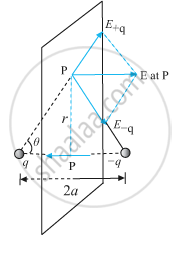
The magnitudes of the electric field due to the two charges +q and −q are given by,

`E_(+q) = ("q")/(4πε_0) (1)/("r"^2 + a^2)`     .....(i)

`E_(-q) = ("q")/(4πε_0) (1)/("r"^2 + a^2)`     .....(i)

∴ `E_(+q) = E_(-q)`

The directions of E+q and E−q are as shown in the figure. The components normal to the dipole axis cancel away. The components along the dipole axis add up.
 Total electric field

`E = -(E_+q + E_-q) cos theta  hat"p"   ... ["negative sign shows that field is opposite to"  hat"p"]`

`E = -(2qa)/(4πε_0("r"^2 + a^2)^(3/2)) hat"p"`    ....(iii)

At large distances (r >> a), this reduces to

`E = -(2qa)/(4πε_0"r"^3)hat"p"`             ....(iv)

`vec"p" = q xx  vec"2a"hat"p"`

`E = (-vec"p")/(4πε_0"r"^3)`    ...(r>>a).

shaalaa.com
  क्या इस प्रश्न या उत्तर में कोई त्रुटि है?
2018-2019 (March) 55/1/3

वीडियो ट्यूटोरियलVIEW ALL [1]

संबंधित प्रश्न

  1. An electrostatic field line is a continuous curve. That is, a field line cannot have sudden breaks. Why not?
  2. Explain why two field lines never cross each other at any point?

Which among the curves shown in the fig. cannot possibly represent electrostatic field lines?

(a)

(b)

(c)

(d)

(e)


A point charge (+Q) is kept in the vicinity of an uncharged conducting plate. Sketch the electric field lines between the charge and the plate?


The figure shows the field lines on a positive charge. Is the work done by the field in moving a small positive charge from Q to P positive or negative? Give reason.


Two bar magnets are quickly moved towards a metallic loop connected across a capacitor ‘C’ as shown in the figure. Predict the polarity of the capacitor.


A thin, metallic spherical shell contains a charge Q on it. A point charge q is placed at the centre of the shell and another charge q1 is placed outside it as shown in the following figure. All the three charges are positive. The force on the central charge due to the shell is ______.


Answer the following question.
Draw the pattern of electric field lines when a point charge +q is kept near an uncharged conducting plate.


Explain why two field lines never cross each other at any point?


A point positive charge is brought near an isolated conducting sphere (figure). The electric field is best given by ______.


Which of the following figures represent the electric field lines due to a single negative charge?


Share
Notifications

Englishहिंदीमराठी


      Forgot password?
Use app×