Advertisements
Advertisements
प्रश्न
Solve the following question.
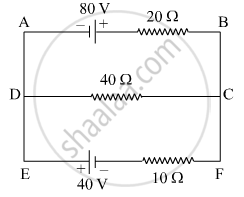
Using Kirchhoff’s rules, calculate the current through the 40 Ω and 20 Ω resistors in the following circuit.
Advertisements
उत्तर
Apply KVL through ABCDA
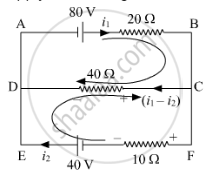
`80 - 20i_1 - 40(i_1 - i_2) = 0`
`80 - 60i_1 + 40i_2 = 0` ....(1)
Apply KVL through FEDCF
`40 + 40(i_1 - i_2) - 10i_2 = 0`
`40 + 40i_1 - 50i_2 = 0` ......(2)
`4i_2 - 6i_1 = -8 (1)` .....[ from (1)]
`-5i_2 + 4i_1 = -4 (2)` .....[ from (2)]
Multiply equation (2) by `6/4` and add with equation (1)
`4i_2 - 6i_1 = -8`
`(-30i_2)/4 + 6i_1 = -6`
__________________________
`4i_2 - 30/4i_2 = -14`
`(-14)/4i_2 = -14`
`i_2 = (-14)/7 xx 2`
`i_2 = 4 A`
Put the value of i2 in equation (1)
`4 xx (4) - 6i_1 = -8`
`16 - 6i_1 = -8`
`6i_1 = 16 + 8 = 24`
`i_1 = 4A`
So, current through 40 Ω resistor = `i_1 - i_2`
= 4 - 4
= 0 A
Hence, current through 20 Ω resistor = 4A.
संबंधित प्रश्न
State the two Kirchhoff’s rules used in electric networks. How are there rules justified?
The current is drawn from a cell of emf E and internal resistance r connected to the network of resistors each of resistance r as shown in the figure. Obtain the expression for
- the current draw from the cell and
- the power consumed in the network.
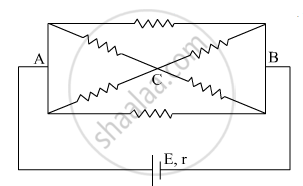
Determine the equivalent resistance of networks shown in Fig.
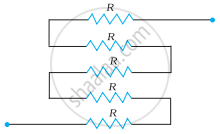
Calculate the value of the resistance R in the circuit shown in the figure so that the current in the circuit is 0.2 A. What would b the potential difference between points A and B?

Consider the following two statements:-
(A) Kirchhoff's junction law follows from conservation of charge.
(B) Kirchhoff's loop law follows from conservative nature of electric field.
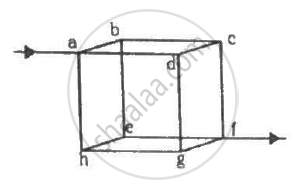
Twelve wires, each of equal resistance r, are joined to form a cube, as shown in the figure. Find the equivalent resistance between the diagonally-opposite points a and f.
In the circuit shown in the figure below, E1 and E2 are two cells having emfs 2 V and 3 V respectively, and negligible internal resistance. Applying Kirchhoff’s laws of electrical networks, find the values of currents l1 and I2.

State Kirchhoff ’s voltage rule.
Obtain the condition for bridge balance in Wheatstone’s bridge.
Two cell of 1.25 V and 0.75 V are connected parallel. The effective voltage will be:-
Why are alloys used for making standard resistance coils?
The value of current in the 6Ω resistance is ______.

At any junction, what does Kirchhoff's Current Law state?
What is a loop?
Which term is defined as the rate of flow of charge through a conductor?
What is potential difference?
Why must the amount of charge entering a junction per second equal the amount leaving when current is steady?
If currents \[I_1\] and \[I_2\] enter a junction and currents \[I_3\] and \[I_4\] leave it, which equation follows from Kirchhoff's First Law?
How are Kirchhoff's laws used in analysing a general network with several unknown branch currents?
