Advertisements
Advertisements
प्रश्न
Lightning is a very good example of a natural current. In typical lightning, there is 109 J energy transfer across the potential difference of 5 × 10⁷ V during a time interval of 0.2 s. Using this information, estimate the following quantities:
- the total amount of charge transferred between cloud and ground
- the current in the lightning bolt
- the power delivered in 0.2 s.

Advertisements
उत्तर
Given data: E = 109J, V = 5 × 10⁷ V, t = 0.2s
(a) Total amount of charge-
W = qv `=> "q" = "W"/"V" = "E"/"V" = 10^9/(5 xx 10^7) = 0.2 xx 10^2`
q = 20 C
(b) current, I = `"q"/"t" = 20/0.2 = 200/2 = 100`
I = 100 A
(c) Power, P = VI = `5 xx 10^7 xx 100 = 5 xx 10^9`
APPEARS IN
संबंधित प्रश्न
Calculate the value of the resistance R in the circuit shown in the figure so that the current in the circuit is 0.2 A. What would b the potential difference between points A and B?

State Kirchhoff ’s voltage rule.
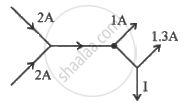
The figure below shows current in a part of electric circuit. The current I is ______.
Two cells of voltage 10V and 2V and internal resistances 10Ω and 5Ω respectively, are connected in parallel with the positive end of 10V battery connected to negative pole of 2V battery (Figure). Find the effective voltage and effective resistance of the combination.

The value of current in the 6Ω resistance is ______.

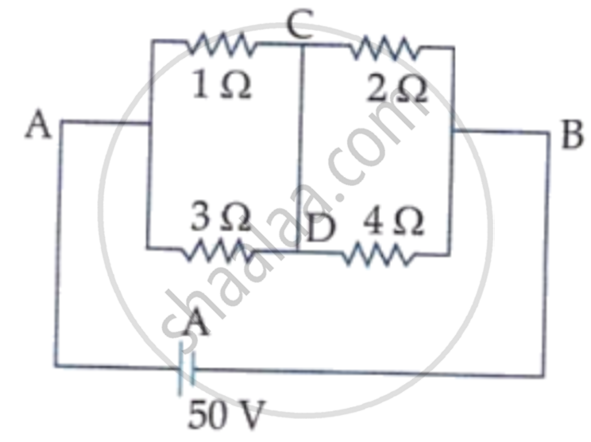
A constant voltage of 50 V is maintained between the points A and B of the circuit shown in the figure. The current through the branch CD of the circuit is:
What is a branch?
Which term is defined as the rate of flow of charge through a conductor?
In a closed loop containing cells and resistors, what equals the total potential drop across the resistors?
While moving opposite to the direction of current through a resistor, how is the potential change treated?
