Advertisements
Advertisements
Question
Lightning is a very good example of a natural current. In typical lightning, there is 109 J energy transfer across the potential difference of 5 × 10⁷ V during a time interval of 0.2 s. Using this information, estimate the following quantities:
- the total amount of charge transferred between cloud and ground
- the current in the lightning bolt
- the power delivered in 0.2 s.

Advertisements
Solution
Given data: E = 109J, V = 5 × 10⁷ V, t = 0.2s
(a) Total amount of charge-
W = qv `=> "q" = "W"/"V" = "E"/"V" = 10^9/(5 xx 10^7) = 0.2 xx 10^2`
q = 20 C
(b) current, I = `"q"/"t" = 20/0.2 = 200/2 = 100`
I = 100 A
(c) Power, P = VI = `5 xx 10^7 xx 100 = 5 xx 10^9`
APPEARS IN
RELATED QUESTIONS
State the two Kirchhoff’s rules used in electric networks. How are there rules justified?
Given the resistances of 1 Ω, 2 Ω, 3 Ω, how will be combine them to get an equivalent resistance of (11/3) Ω?
Given the resistances of 1 Ω, 2 Ω, 3 Ω, how will be combine them to get an equivalent resistance of 6 Ω?
A capacitor of capacitance 8.0 μF is connected to a battery of emf 6.0 V through a resistance of 24 Ω. Find the current in the circuit (a) just after the connections are made and (b) one time constant after the connections are made.
In the circuit shown in the figure below, E1 and E2 are two cells having emfs 2 V and 3 V respectively, and negligible internal resistance. Applying Kirchhoff’s laws of electrical networks, find the values of currents l1 and I2.

Solve the following question.
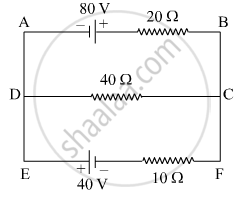
Using Kirchhoff’s rules, calculate the current through the 40 Ω and 20 Ω resistors in the following circuit.
Kirchhoff s second law is based on the law of conservation of ______
Two cells of voltage 10V and 2V and internal resistances 10Ω and 5Ω respectively, are connected in parallel with the positive end of 10V battery connected to negative pole of 2V battery (Figure). Find the effective voltage and effective resistance of the combination.

What is emf?
Why must the amount of charge entering a junction per second equal the amount leaving when current is steady?
