Advertisements
Advertisements
Question
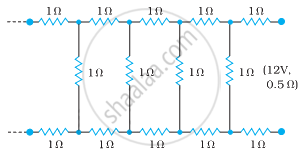
Determine the current drawn from a 12 V supply with internal resistance 0.5 Ω by the infinite network shown in the figure. Each resistor has 1 Ω resistance.
Advertisements
Solution
The resistance of each resistor connected in the given circuit, R = 1 Ω
Equivalent resistance of the given circuit = R’
The network is infinite. Hence, equivalent resistance is given by the relation,
∴ R' = `2 + "R'"/(("R'" + 1))`
`("R'")^2 - 2"R'" - 2 = 0`
R' = `(2 ± sqrt(4 + 8))/2`
= `(2 ± sqrt12)/2`
= `1 ± sqrt3`
Negative value of R’ cannot be accepted. Hence, equivalent resistance,
R' = `(1 + sqrt3)` = 1 + 1.73 = 2.73 Ω
Internal resistance of the circuit, r = 0.5 Ω
Hence, total resistance of the given circuit = 2.73 + 0.5 = 3.23 Ω
Supply voltage, V = 12 V
According to Ohm’s Law, current drawn from the source is given by the ratio, `12/3.23` = 3.72 A
APPEARS IN
RELATED QUESTIONS
State the two Kirchhoff’s rules used in electric networks. How are there rules justified?
Use Kirchhoff's rules to obtain conditions for the balance condition in a Wheatstone bridge.
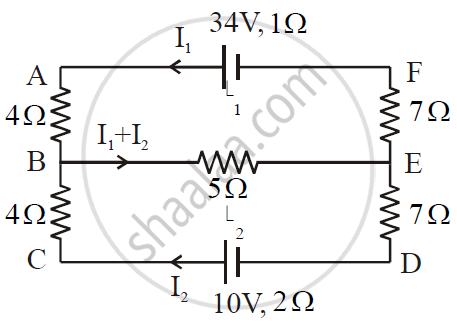
ε1 and ε2 are two batteries having emf of 34V and 10V respectively and internal resistance of 1Ω and 2Ω respectively. They are connected as shown in the figure below. Using Kirchhoff’s Laws of electrical networks, calculate the currents I1 and I2.
Given the resistances of 1 Ω, 2 Ω, 3 Ω, how will be combine them to get an equivalent resistance of (11/3) Ω?
Given the resistances of 1 Ω, 2 Ω, 3 Ω, how will be combine them to get an equivalent resistance of 6 Ω?
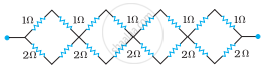
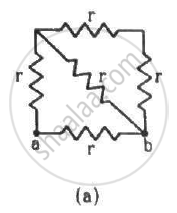
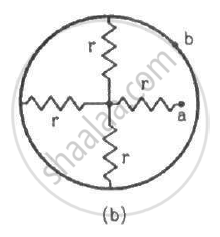
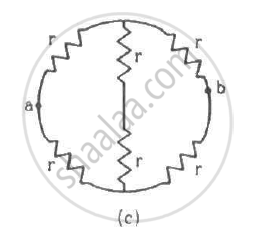
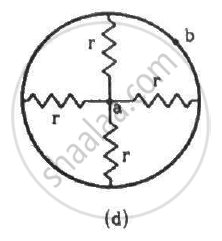
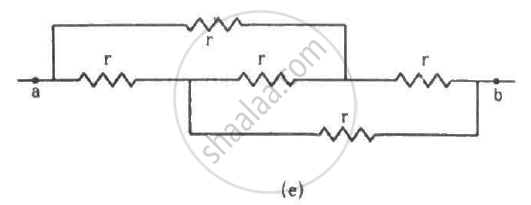
Determine the equivalent resistance of networks shown in Fig.
In the given circuit, assuming point A to be at zero potential, use Kirchhoff’s rules to determine the potential at point B.

Consider the following two statements:-
(A) Kirchhoff's junction law follows from conservation of charge.
(B) Kirchhoff's loop law follows from conservative nature of electric field.
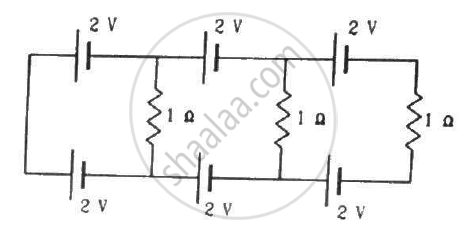
Find the circuit in the three resistors shown in the figure.
Find the equivalent resistances of the networks shown in the figure between the points a and b.
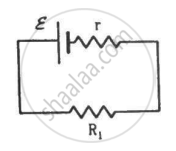
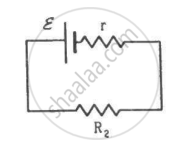
Two unequal resistances, R1 and R2, are connected across two identical batteries of emf ε and internal resistance r (see the figure). Can the thermal energies developed in R1 and R2 be equal in a given time? If yes, what will be the condition?
On which conservation principle is Kirchoff's Second Law of electrical networks based?
Solve the following question.
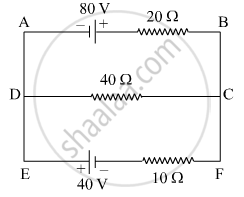
Using Kirchhoff’s rules, calculate the current through the 40 Ω and 20 Ω resistors in the following circuit.
State Kirchhoff’s current rule.
State and explain Kirchhoff’s rules.
A copper wire of 10-6 m2 area of cross-section, carries a current of 2 A. If the number of electrons per cubic meter is 8 × 1028, calculate the current density and average drift velocity.
The instrument for the accurate measurement of the e.m.f of a cell is ______.
Assertion: Kirchhoff’s junction rule follows from conservation of charge.
Reason: Kirchhoff’s loop rule follows from conservation of momentum.
The e.m.f of The battery in a thermocouple is doubled. The rate of heat generated at one of the junction will.
Kirchhoff’s junction rule is a reflection of ______.
- conservation of current density vector.
- conservation of charge.
- the fact that the momentum with which a charged particle approaches a junction is unchanged (as a vector) as the charged particle leaves the junction.
- the fact that there is no accumulation of charges at a junction.
Power P is to be delivered to a device via transmission cables having resistance RC. If V is the voltage across R and I the current through it, find the power wasted and how can it be reduced.
Two cells of voltage 10V and 2V and internal resistances 10Ω and 5Ω respectively, are connected in parallel with the positive end of 10V battery connected to negative pole of 2V battery (Figure). Find the effective voltage and effective resistance of the combination.

Derive the equation of the balanced state in a Wheatstone bridge using Kirchhoff’s laws.
The value of current in the 6Ω resistance is ______.

A 6-volt battery is connected to the terminals of a three-metre-long wire of uniform thickness and resistance of 100 ohms. The difference of potential between two points on the wire separated by a distance of 50 cm will be ______.
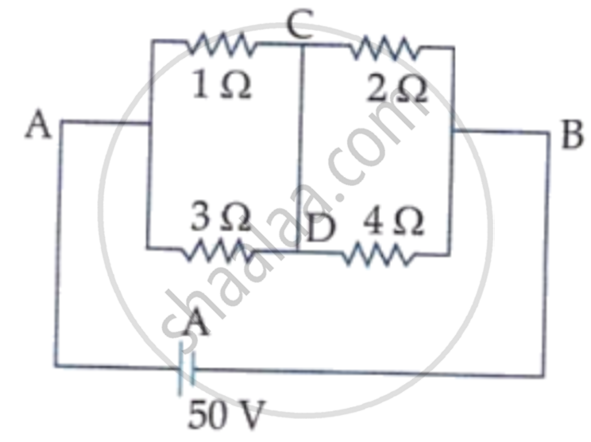
A constant voltage of 50 V is maintained between the points A and B of the circuit shown in the figure. The current through the branch CD of the circuit is:
Which mathematical form represents Kirchhoff's Current Law using an algebraic sum of currents?
Which pair of equations expresses the loop relationship for cells and resistors?
What is a branch?
What is a loop?
What is potential difference?
In a closed loop containing cells and resistors, what equals the total potential drop across the resistors?
How are Kirchhoff's laws used in analysing a general network with several unknown branch currents?
