Advertisements
Advertisements
Question
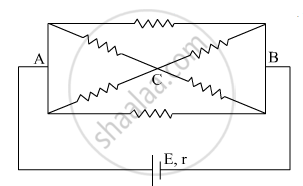
The current is drawn from a cell of emf E and internal resistance r connected to the network of resistors each of resistance r as shown in the figure. Obtain the expression for
- the current draw from the cell and
- the power consumed in the network.
Advertisements
Solution
From the above figure we can use the horizontal symmetry to deduce the current.
As both resistance in the circuit as well as the internal resistance in the circuit have the same resistance 'r'
The resistance of the loop I will be
`1/R_I=1/r+1/(2r)`
`1/R_I=(3r)/(2r^2)`
`R_I=(2r)/3`
Because the circuit I and II are same we can say
RII=(2r)/3
Combined resistance will be
R = RI + RII
`1/R=1/R_(I)+1/R_(II)`
`1/R=1/((2r)/3)+1/((2r)/3)`
`1/R=2×(1/((2r)/3))`
`R=r/3`
Now this circuit is series with internal resistance 'r'
Resultant resistance will be
`R_("resultant")=(4r)/3`
The current drawn from the cell will be
`I=(3E)/(4r)`
And power consumed by the network
`P=I^2/R`
`P=(9E^2)/(16r^2)×(4r)/3`
`P=(3E^2)/(4r)`
APPEARS IN
RELATED QUESTIONS
Kirchhoff's voltage law and current law are respectively in accordance with the conservation of .................................. .
- charge and momentum
- charge and energy
- energy and charge
- energy and momentum
Given the resistances of 1 Ω, 2 Ω, 3 Ω, how will be combine them to get an equivalent resistance of 6 Ω?
State Kirchhoff's rules for an electric network. Using Kirchhoff's rules, obtain the balance condition in terms of the resistances of four arms of Wheatstone bridge.
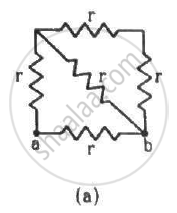
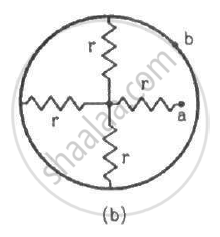
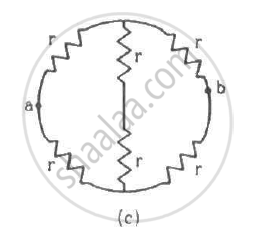
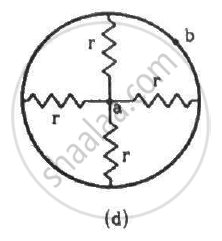
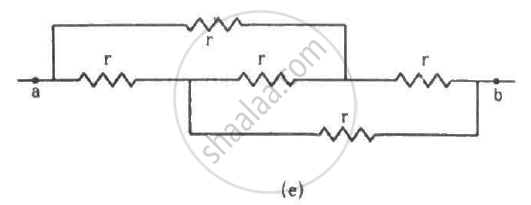
Find the equivalent resistances of the networks shown in the figure between the points a and b.
Solve the following question.
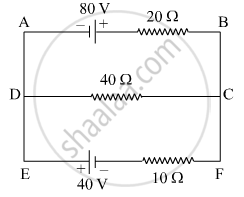
Using Kirchhoff’s rules, calculate the current through the 40 Ω and 20 Ω resistors in the following circuit.
Obtain the condition for bridge balance in Wheatstone’s bridge.
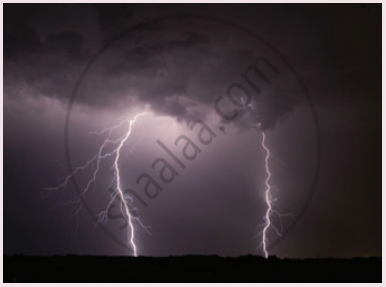
Lightning is a very good example of a natural current. In typical lightning, there is 109 J energy transfer across the potential difference of 5 × 10⁷ V during a time interval of 0.2 s. Using this information, estimate the following quantities:
- the total amount of charge transferred between cloud and ground
- the current in the lightning bolt
- the power delivered in 0.2 s.
In a meter bridge the point D is a neutral point (Figure).
- The meter bridge can have no other neutral point for this set of resistances.
- When the jockey contacts a point on meter wire left of D, current flows to B from the wire.
- When the jockey contacts a point on the meter wire to the right of D, current flows from B to the wire through galvanometer.
- When R is increased, the neutral point shifts to left.
Why are alloys used for making standard resistance coils?
Power P is to be delivered to a device via transmission cables having resistance RC. If V is the voltage across R and I the current through it, find the power wasted and how can it be reduced.
Derive the equation of the balanced state in a Wheatstone bridge using Kirchhoff’s laws.
In the circuit shown in Figure below, E1 and E2 are batteries having emfs of 25V and 26V. They have an internal resistance of 1 Ω and 5 Ω respectively. Applying Kirchhoff’s laws of electrical networks, calculate the currents I1 and I2.

Which pair of equations expresses the loop relationship for cells and resistors?
What is a junction or node?
What is emf?
In a closed loop containing cells and resistors, what equals the total potential drop across the resistors?
What is the sign of the emf when moving from the negative terminal to the positive terminal of a cell?
At junction P, currents \[0.2\,\mathrm{A}\], \[0.6\,\mathrm{A}\], and \[0.7\,\mathrm{A}\] point towards P, while \[0.4\,\mathrm{A}\], \[0.5\,\mathrm{A}\], and \[I\] point away. What is the unknown current?
