Advertisements
Advertisements
प्रश्न
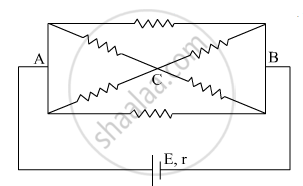
The current is drawn from a cell of emf E and internal resistance r connected to the network of resistors each of resistance r as shown in the figure. Obtain the expression for
- the current draw from the cell and
- the power consumed in the network.
Advertisements
उत्तर
From the above figure we can use the horizontal symmetry to deduce the current.
As both resistance in the circuit as well as the internal resistance in the circuit have the same resistance 'r'
The resistance of the loop I will be
`1/R_I=1/r+1/(2r)`
`1/R_I=(3r)/(2r^2)`
`R_I=(2r)/3`
Because the circuit I and II are same we can say
RII=(2r)/3
Combined resistance will be
R = RI + RII
`1/R=1/R_(I)+1/R_(II)`
`1/R=1/((2r)/3)+1/((2r)/3)`
`1/R=2×(1/((2r)/3))`
`R=r/3`
Now this circuit is series with internal resistance 'r'
Resultant resistance will be
`R_("resultant")=(4r)/3`
The current drawn from the cell will be
`I=(3E)/(4r)`
And power consumed by the network
`P=I^2/R`
`P=(9E^2)/(16r^2)×(4r)/3`
`P=(3E^2)/(4r)`
APPEARS IN
संबंधित प्रश्न
Given n resistors each of resistance R, how will you combine them to get the (i) maximum (ii) minimum effective resistance? What is the ratio of the maximum to minimum resistance?
Given the resistances of 1 Ω, 2 Ω, 3 Ω, how will be combine them to get an equivalent resistance of (11/5) Ω?
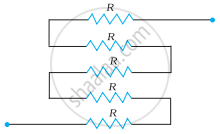
Determine the equivalent resistance of networks shown in Fig.
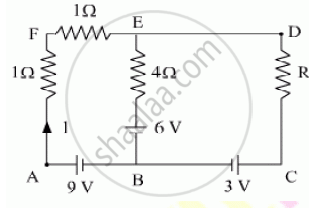
Using Kirchhoff’s rules determine the value of unknown resistance R in the circuit so that no current flows through 4 Ω resistance. Also find the potential difference between A and D.
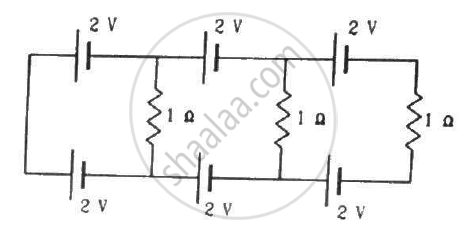
Find the circuit in the three resistors shown in the figure.
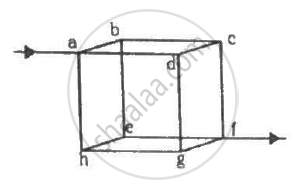
Twelve wires, each of equal resistance r, are joined to form a cube, as shown in the figure. Find the equivalent resistance between the diagonally-opposite points a and f.
In the circuit shown in the figure below, E1 and E2 are two cells having emfs 2 V and 3 V respectively, and negligible internal resistance. Applying Kirchhoff’s laws of electrical networks, find the values of currents l1 and I2.

A copper wire of 10-6 m2 area of cross-section, carries a current of 2 A. If the number of electrons per cubic meter is 8 × 1028, calculate the current density and average drift velocity.
In a potentiometer arrangement, a cell of emf 1.25 V gives a balance point at 35 cm length of the wire. If the cell is replaced by another cell and the balance point shifts to 63 cm, what is the emf of the second cell?
The Kirchhoff's second law (ΣiR = ΣE), where the symbols have their usual meanings, is based on ______.
Kirchhoff’s junction rule is a reflection of ______.
- conservation of current density vector.
- conservation of charge.
- the fact that the momentum with which a charged particle approaches a junction is unchanged (as a vector) as the charged particle leaves the junction.
- the fact that there is no accumulation of charges at a junction.
State the two Kirchhoff’s rules used in the analysis of electric circuits and explain them.
Who gave Kirchhoff's laws?
What does Kirchhoff's Voltage Law state for a closed loop?
What is emf?
While moving in the direction of current through a resistor, how is the potential change treated?
At junction P, currents \[0.2\,\mathrm{A}\], \[0.6\,\mathrm{A}\], and \[0.7\,\mathrm{A}\] point towards P, while \[0.4\,\mathrm{A}\], \[0.5\,\mathrm{A}\], and \[I\] point away. What is the unknown current?
How are Kirchhoff's laws used in analysing a general network with several unknown branch currents?
