Advertisements
Advertisements
प्रश्न
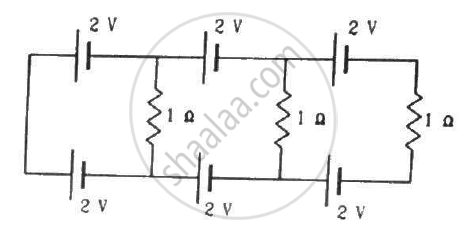
Find the circuit in the three resistors shown in the figure.
Advertisements
उत्तर
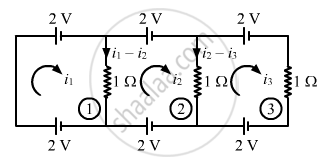
Applying KVL in loop 1, we get:-
\[2 + \left( i_1 - i_2 \right) \times 1 - 2 = 0\]
\[ \Rightarrow i_1 = i_2\]
Applying KVL in loop 2, we get:-
\[2 + \left( i_2 - i_3 \right) \times 1 - 2 - \left( i_1 - i_2 \right) \times 1 = 0\]
\[ \Rightarrow i_2 - i_3 - i_1 + i_2 = 0\]
\[ i_1 = i_2 \]
\[ \Rightarrow i_2 - i_3 - i_2 + i_2 = 0\]
\[ \Rightarrow i_2 = i_3\]
Applying KVL in loop 3, we get:-
\[2 + i_3 - 2 - \left( i_2 - i_3 \right) = 0\]
\[ \Rightarrow i_3 = 0\]
\[ i_1 = i_2 = i_3 \]
\[ \therefore i_1 = i_2 = i_3 = 0\]
APPEARS IN
संबंधित प्रश्न
Kirchhoff's voltage law and current law are respectively in accordance with the conservation of .................................. .
- charge and momentum
- charge and energy
- energy and charge
- energy and momentum
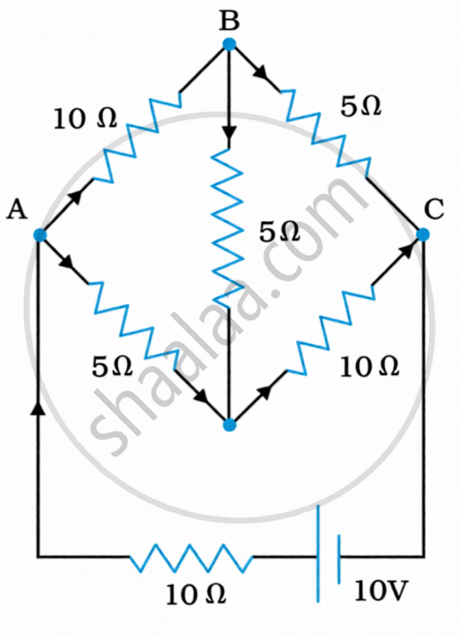
Determine the current in each branch of the network shown in figure.
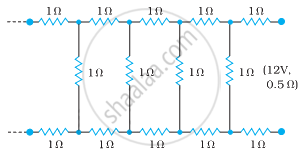
Determine the current drawn from a 12 V supply with internal resistance 0.5 Ω by the infinite network shown in the figure. Each resistor has 1 Ω resistance.
Given the resistances of 1 Ω, 2 Ω, 3 Ω, how will be combine them to get an equivalent resistance of (11/3) Ω?
Given the resistances of 1 Ω, 2 Ω, 3 Ω, how will be combine them to get an equivalent resistance of (11/5) Ω?
Given the resistances of 1 Ω, 2 Ω, 3 Ω, how will be combine them to get an equivalent resistance of 6 Ω?
Given the resistances of 1 Ω, 2 Ω, 3 Ω, how will be combine them to get an equivalent resistance of (6/11) Ω?
State Kirchhoff's rules for an electric network. Using Kirchhoff's rules, obtain the balance condition in terms of the resistances of four arms of Wheatstone bridge.
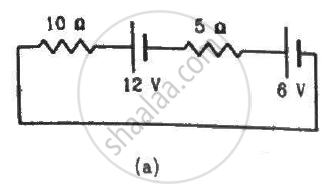
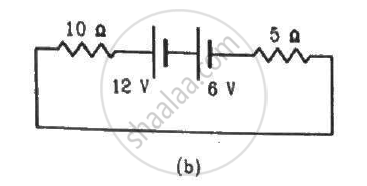
Consider the circuit shown in the figure. Find (a) the current in the circuit (b) the potential drop across the 5 Ω resistor (c) the potential drop across the 10 Ω resistor (d) Answer the parts (a), (b) and (c) with reference to the figure.
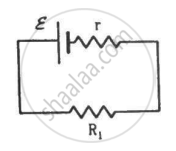
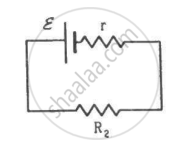
Two unequal resistances, R1 and R2, are connected across two identical batteries of emf ε and internal resistance r (see the figure). Can the thermal energies developed in R1 and R2 be equal in a given time? If yes, what will be the condition?
Solve the following question.
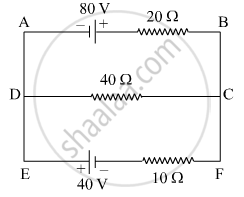
Using Kirchhoff’s rules, calculate the current through the 40 Ω and 20 Ω resistors in the following circuit.
State Kirchhoff’s current rule.
State Kirchhoff ’s voltage rule.
State and explain Kirchhoff’s rules.
Obtain the condition for bridge balance in Wheatstone’s bridge.
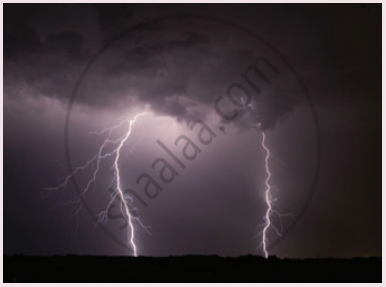
Lightning is a very good example of a natural current. In typical lightning, there is 109 J energy transfer across the potential difference of 5 × 10⁷ V during a time interval of 0.2 s. Using this information, estimate the following quantities:
- the total amount of charge transferred between cloud and ground
- the current in the lightning bolt
- the power delivered in 0.2 s.
Kirchhoff’s second law is a consequence of law of conservation of ______.
Assertion: Kirchhoff’s junction rule follows from conservation of charge.
Reason: Kirchhoff’s loop rule follows from conservation of momentum.
The Kirchhoff's second law (ΣiR = ΣE), where the symbols have their usual meanings, is based on ______.
Two cell of 1.25 V and 0.75 V are connected parallel. The effective voltage will be:-
The e.m.f of The battery in a thermocouple is doubled. The rate of heat generated at one of the junction will.
Three resistors having resistances r1, r2 and r3 are connected as shown in the given circuit. The ratio `i_3/i_1` of currents in terms of resistances used in the circuit is:
What are the advantages of the null-point method in a Wheatstone bridge? What additional measurements would be required to calculate `R_(unknown)` by any other method?
Two cells of voltage 10V and 2V and internal resistances 10Ω and 5Ω respectively, are connected in parallel with the positive end of 10V battery connected to negative pole of 2V battery (Figure). Find the effective voltage and effective resistance of the combination.

State the two Kirchhoff’s rules used in the analysis of electric circuits and explain them.
The figure below shows two batteries, E1 and E2, having emfs of 18V and 10V and internal resistances of 1 Ω and 2 Ω, respectively. W1, W2 and W3 are uniform metallic wires AC, FD and BE having resistances of 8 Ω, 6 Ω and 10 Ω respectively. B and E are midpoints of the wires W1 and W2. Using Kirchhoff's laws of electrical circuits, calculate the current flowing in the wire W3:

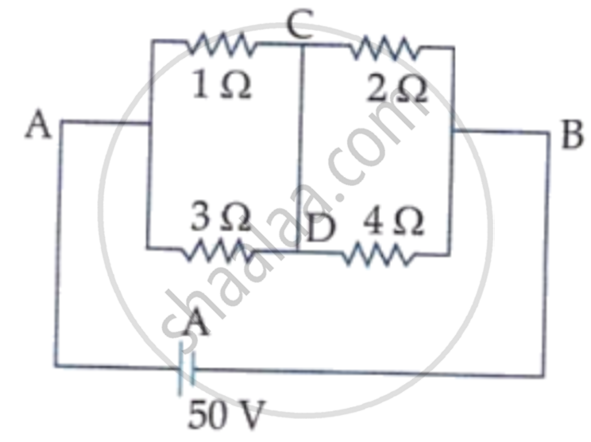
A constant voltage of 50 V is maintained between the points A and B of the circuit shown in the figure. The current through the branch CD of the circuit is:
Who gave Kirchhoff's laws?
What is a junction or node?
What is a branch?
Which term is defined as the rate of flow of charge through a conductor?
What is potential difference?
After a charge completes one full loop and returns to its starting point, what is the net change in potential?
Which sign convention is usually used for current leaving a junction?
What is the sign of the emf when moving from the negative terminal to the positive terminal of a cell?
How are Kirchhoff's laws used in analysing a general network with several unknown branch currents?
