Advertisements
Advertisements
प्रश्न
In a potentiometer arrangement, a cell of emf 1.25 V gives a balance point at 35 cm length of the wire. If the cell is replaced by another cell and the balance point shifts to 63 cm, what is the emf of the second cell?
Advertisements
उत्तर
Emf of the cell1, ξ1 = 1.25 V
Balancing length of the cell, l1 = 35 cm = 35 x 10-2 m
Balancing length after interchanged, l2 = 63 cm = 63 x 10-2 m
Emf of the cell1, ξ2 = ?
The ration of emf’s, `ξ_1/ξ_2 = l_1/l_2`
The ration of emf’s, ξ2 = ξ1 = `(l_2/l_1)`
= 1. 25 `xx ((63 xx 10^-2)/(35 xx 10^-2)) = 12.5 xx 1.8`
ξ2 = 2.25 V.
APPEARS IN
संबंधित प्रश्न
State the two Kirchhoff’s rules used in electric networks. How are there rules justified?
Use Kirchhoff's rules to obtain conditions for the balance condition in a Wheatstone bridge.
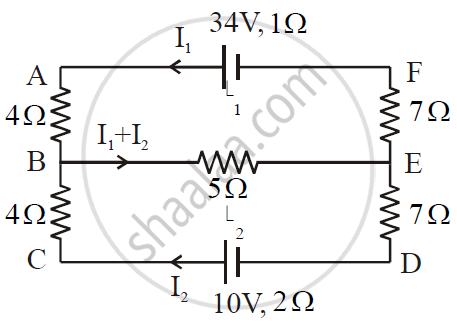
ε1 and ε2 are two batteries having emf of 34V and 10V respectively and internal resistance of 1Ω and 2Ω respectively. They are connected as shown in the figure below. Using Kirchhoff’s Laws of electrical networks, calculate the currents I1 and I2.
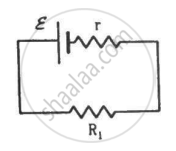
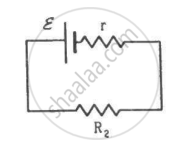
Two unequal resistances, R1 and R2, are connected across two identical batteries of emf ε and internal resistance r (see the figure). Can the thermal energies developed in R1 and R2 be equal in a given time? If yes, what will be the condition?
Obtain the condition for bridge balance in Wheatstone’s bridge.
State the two Kirchhoff’s rules used in the analysis of electric circuits and explain them.
The figure below shows two batteries, E1 and E2, having emfs of 18V and 10V and internal resistances of 1 Ω and 2 Ω, respectively. W1, W2 and W3 are uniform metallic wires AC, FD and BE having resistances of 8 Ω, 6 Ω and 10 Ω respectively. B and E are midpoints of the wires W1 and W2. Using Kirchhoff's laws of electrical circuits, calculate the current flowing in the wire W3:

At any junction, what does Kirchhoff's Current Law state?
Which algebraic form is equivalent to \[I_1+I_2=I_3+I_4\]?
How are Kirchhoff's laws used in analysing a general network with several unknown branch currents?
