Advertisements
Advertisements
Question
In a potentiometer arrangement, a cell of emf 1.25 V gives a balance point at 35 cm length of the wire. If the cell is replaced by another cell and the balance point shifts to 63 cm, what is the emf of the second cell?
Advertisements
Solution
Emf of the cell1, ξ1 = 1.25 V
Balancing length of the cell, l1 = 35 cm = 35 x 10-2 m
Balancing length after interchanged, l2 = 63 cm = 63 x 10-2 m
Emf of the cell1, ξ2 = ?
The ration of emf’s, `ξ_1/ξ_2 = l_1/l_2`
The ration of emf’s, ξ2 = ξ1 = `(l_2/l_1)`
= 1. 25 `xx ((63 xx 10^-2)/(35 xx 10^-2)) = 12.5 xx 1.8`
ξ2 = 2.25 V.
APPEARS IN
RELATED QUESTIONS
State the two Kirchhoff’s rules used in electric networks. How are there rules justified?
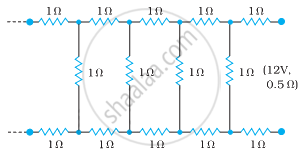
Determine the current drawn from a 12 V supply with internal resistance 0.5 Ω by the infinite network shown in the figure. Each resistor has 1 Ω resistance.
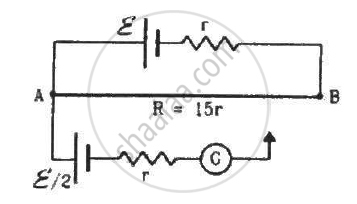
Consider the potentiometer circuit as arranged in the figure. The potentiometer wire is 600 cm long. (a) At what distance from the point A should the jockey touch the wire to get zero deflection in the galvanometer? (b) If the jockey touches the wire at a distance of 560 cm from A, what will be the current in the galvanometer?
State Kirchhoff’s current rule.
State Kirchhoff ’s voltage rule.
The instrument for the accurate measurement of the e.m.f of a cell is ______.
What are the advantages of the null-point method in a Wheatstone bridge? What additional measurements would be required to calculate `R_(unknown)` by any other method?
Who gave Kirchhoff's laws?
What is a branch?
What is emf?
