Advertisements
Advertisements
Question
State Kirchhoff’s current rule.
Advertisements
Solution
- Kirchhoff’s current rule states that the algebraic sum of the currents at any junction of a circuit is zero.
i.e `Σ_"junction"` i = 0 - It is a statement of conservation of electric charge.
APPEARS IN
RELATED QUESTIONS
State Kirchhoff's rules and explain on what basis they are justified.
In the circuit shown in the figure below, E1 and E2 are two cells having emfs 2 V and 3 V respectively, and negligible internal resistance. Applying Kirchhoff’s laws of electrical networks, find the values of currents l1 and I2.

Obtain the condition for bridge balance in Wheatstone’s bridge.
Assertion: Kirchhoff’s junction rule follows from conservation of charge.
Reason: Kirchhoff’s loop rule follows from conservation of momentum.
While measuring the length of the rod by vernier callipers, the reading on the main scale is 6.4 cm and the eight divisions on vernier is in line with marking on the main scale division. If the least count of callipers is 0.01 and zero error - 0.04 cm, the length of the rod is ______.
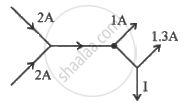
The figure below shows current in a part of electric circuit. The current I is ______.
The circuit in figure shows two cells connected in opposition to each other. Cell E1 is of emf 6V and internal resistance 2Ω; the cell E2 is of emf 4V and internal resistance 8Ω. Find the potential difference between the points A and B.
Which two basic physical principles form the basis of Kirchhoff's laws?
What does Kirchhoff's Voltage Law state for a closed loop?
What is a branch?
